Science Workbook Alternatives for Elementary Students

Table of Contents
- Why Science Workbook Alternatives Matter for Elementary Learners
- Inquiry-Based Science Activities for Kids: Building Critical Thinking
- Hands-On Science Curriculum for Elementary: Learning Through Experimentation
- Story-Driven Science Learning: Narrative as a Teaching Tool
- Living Books and Trade Books: Real Science Through Engaging Narratives
- Integrating Science Alternatives Into Your Classroom or Home
- Conclusion: Building a Deeper Love of Science
- Frequently Asked Questions
Last Updated: October 2, 2026
Why Science Workbook Alternatives Matter for Elementary Learners
Traditional science workbooks reduce learning to fill-in-the-blank exercises and rote memorization, disconnecting students from curiosity. Story-driven learning improves retention and deepens enthusiasm for science.
Children learn best when genuinely curious. A student reading about ecosystem feedback loops through narrative builds mental models of how the world works, not just memorized facts.
Traditional worksheets create passive learners with no space for wonder. Science workbook alternatives position children as explorers rather than assignment-completers.
This matters because elementary years are when scientific literacy takes root. According to National Science Teaching Association research on inquiry-based learning, students who engage in hands-on, curiosity-driven science develop stronger critical thinking skills than those who rely solely on textbook instruction. The foundation you build now shapes whether science becomes a lifelong interest or just another subject to endure.
Inquiry-Based Science Activities for Kids: Building Critical Thinking
Inquiry-based learning flips the traditional model: students ask questions and investigate answers themselves, developing critical thinking through observation, hypothesis, testing, and revision.
Elementary students thrive with inquiry-based activities because they align with natural learning. A child designing an experiment to test "Why do plants need sunlight?" learns more than from reading about photosynthesis.
Effective inquiry-based activities start with genuine questions students want to solve, provide materials and time to experiment, and encourage revision when evidence contradicts predictions.
Inquiry-based activities increase engagement visibly: students stay focused when conducting investigations that answer questions they care about.
| Activity Type | Learning Focus | Student Role | Time Requirement |
|---|---|---|---|
| Observation investigations | Noticing patterns | Observer and recorder | 15-30 minutes |
| Hands-on experiments | Testing hypotheses | Experimenter | 30-45 minutes |
| Data collection activities | Recording and analyzing | Data scientist | 20-40 minutes |
| Peer discussions | Explaining findings | Communicator | 10-20 minutes |
Hands-On Science Curriculum for Elementary: Learning Through Experimentation
A hands-on science curriculum prioritizes experiential learning.
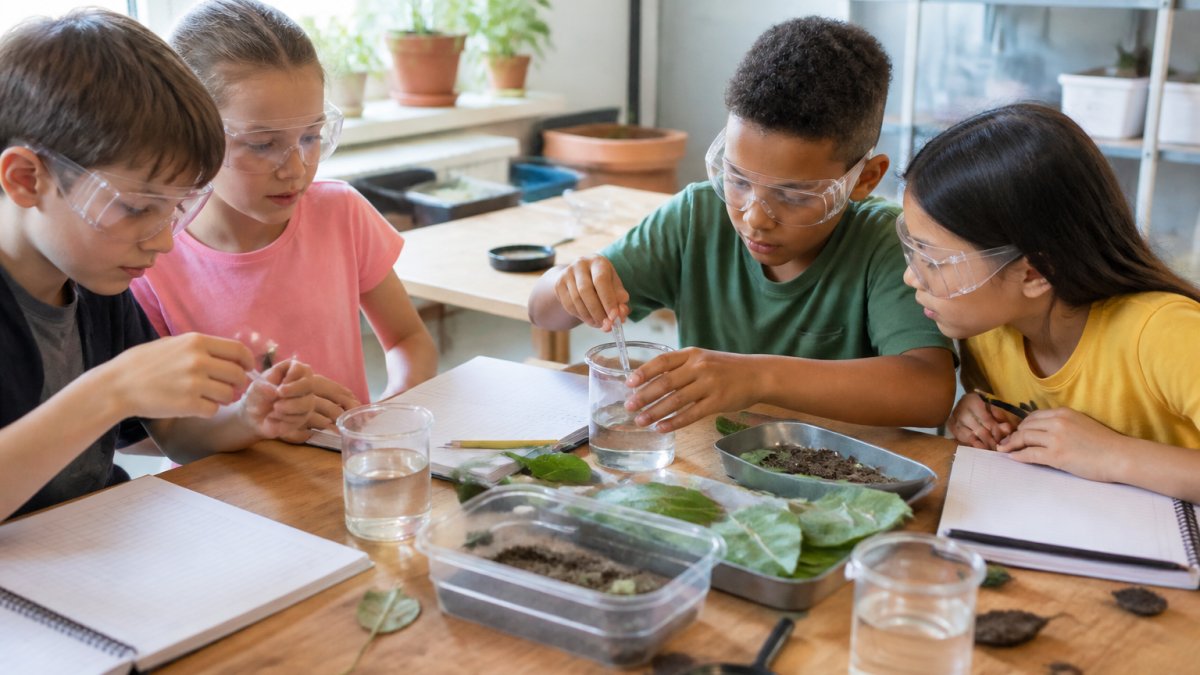
Hands-on experimentation develops observational skills that transfer across subjects, strengthening foundational learning.
Building a Low-Cost Materials Library
A hands-on science curriculum requires no expensive equipment.
Water and containers: Clear plastic bottles and jars enable investigations into floating, sinking, water displacement, and plant growth.
Natural materials: Leaves, twigs, rocks, soil, and seeds from outside provide observational opportunities and cost nothing.
Structuring Open-Ended Investigations
A strong investigation structure includes:
-
A genuine phenomenon or question: Start with something observable that students actually wonder about. "Why do some things float and others sink?" or "How does a plant know which way to grow?" These are real questions with non-obvious answers.
-
Student prediction: Before investigating, ask students what they think will happen and why. This activates prior knowledge and gives them a stake in the outcome. Write predictions down so students can compare them to actual results later.
-
Materials and method: Provide access to materials and let students design how to test their prediction. Offer guidance if needed ("You can use these containers and water to test your idea"), but avoid scripting every step. The design process is part of the learning.
-
Observation and data collection: Students observe what actually happens and record it. Recording can be sketches, written notes, measurements, or photos, whatever captures the important information. Encourage detailed observation: "What color is it? How fast does it move? Does it change over time?"
-
Comparison and reflection: After the investigation, students compare their prediction to their results. Did they match? If not, why? What would they test next? This reflection is where understanding deepens. Students revise their thinking based on evidence, which is the essence of scientific thinking.
For example, students notice a plant leaning toward the window and predict what happens if rotated away.
Adapting Investigations for Different Learners
Not all students approach hands-on learning the same way. Some need more structure; others need more freedom.
Troubleshooting Common Issues
Unexpected results: Students learn more from unexpected outcomes.
A hands-on science curriculum uses seeds, water, household items, and natural materials.
Story-Driven Science Learning: Narrative as a Teaching Tool
Story-driven science learning embeds science in narrative, using characters and plot to make abstract ideas concrete and relatable.
Following a character who discovers why a plant grows toward light creates context and makes the science stick, unlike a definition of photosynthesis.
Narrative learning engages multiple brain regions simultaneously, improving retention and building conceptual understanding through imagination and empathy.
Story-driven science learning keeps reluctant readers engaged; a child who resists textbooks might devour a narrative that weaves science into an adventure.
Lifeweaver --The Realm Of Life Science Lesson 1 Q →
The best story-driven science learning maintains scientific accuracy while prioritizing narrative engagement. Characters face real scientific problems, make observations, and draw conclusions based on evidence. The story doesn't simplify science, it contextualizes it.
Living Books and Trade Books: Real Science Through Engaging Narratives
Living books are narratives written by authors passionate about their subject, crafted to spark curiosity rather than deliver curriculum. Trade books are published books written for general audiences, not as textbooks.
Living books and trade books introduce real scientists and discoveries through engaging narratives. A child reading about Marie Curie learns the human struggle and obstacles, making science meaningful.
Living books integrated with hands-on activities build understanding neither alone achieves: reading provides context, observation provides evidence.
Living books and trade books deepen engagement and understanding as supplemental resources, not curriculum replacements.
Trade books teach multiple disciplines simultaneously; a book about flight history teaches science, history, and engineering, showing how disciplines connect.
American Association of School Librarians' guidance on selecting quality trade books for science learning emphasizes that living books and trade books should be chosen for both accuracy and engagement. A well-written narrative that captures scientific truth is more valuable than a mediocre workbook that covers more ground.
Integrating Science Alternatives Into Your Classroom or Home
Integration requires intentional planning. A practical framework helps transition without losing structure, accountability, or pacing.
Phase 1: Audit and Identify (Week 1-2)
Map current workbook units and learning objectives, then identify which could shift to inquiry-based activities, story-driven learning, or hands-on experiments.
Phase 2: Hybrid Integration (Weeks 3-8)
Layer alternatives alongside existing materials: Monday-Tuesday narrative introduction (living books, trade books, Lifeweaver series); Wednesday-Thursday hands-on investigation; Friday reflection and assessment through student explanation rather than worksheets.

This rhythm maintains structure while shifting cognitive load from memorization to investigation.
Phase 3: Assessment Redesign (Ongoing)
Tracking qualitative measures takes less time than grading worksheets and provides more useful information about student understanding.
Phase 4: Full Integration (Month 3+)
After 2-3 units, develop intuition for needed structure.
Homeschooling parents can structure weeks around story-driven learning and hands-on experiments.
Common Transition Challenges and Solutions
Vocabulary emerges naturally through investigation and narrative.
Map alternative activities to state science standards explicitly. Keep observation notes and work samples as evidence.
Scaffold open-ended tasks with sentence starters, choice of questions, or structured prompts. Gradually build independence rather than removing all support.
Conclusion: Building a Deeper Love of Science
The shift to science workbook alternatives represents a fundamental change: students learn concepts, develop skills, and meet standards through genuine curiosity and meaningful engagement rather than compliance.
Science workbook alternatives align learning with how brains work: we're wired for stories, driven by curiosity, and motivated by autonomy. When education taps these drives, students ask "Can we do more science?" instead of "When do we have to?"
Elementary years determine whether children see science as for them. Worksheet-focused learning suggests science is boring; investigation, narrative, and experiments build a relationship rooted in wonder.
Capite Universe helps families and educators make this shift with story-driven science learning that transforms how children experience science. Our lessons blend narrative engagement with scientific accuracy, giving students the context they need to understand why science matters. With features like the Lifeweaver series exploring life systems and Chemistry in Time revealing how matter shaped civilization, we provide the narrative foundation that makes hands-on learning and inquiry-based activities more meaningful. Start building your child's love of science with Capite Universe's structured educational adventures, where curiosity drives every lesson and understanding runs deeper than any workbook can reach.

Frequently Asked Questions
How can I teach science to elementary students without workbooks?
Replace traditional workbooks with inquiry-based science activities that let children ask questions, conduct experiments, and explore concepts hands-on. Use story-driven science learning platforms that weave narrative into lessons, living books that tell science through engaging stories, and real experiments using household materials. This approach builds curiosity and deeper conceptual understanding rather than relying on worksheets and fill-in-the-blank exercises.
What are the benefits of inquiry-based science learning for elementary kids?
Inquiry-based science activities develop critical thinking, observational skills, and scientific literacy by letting children investigate questions they genuinely care about. Instead of memorizing facts, students design experiments, collect data, and draw conclusions. This method increases engagement, improves retention, and fosters a genuine love of science discovery rather than passive worksheet completion.
Are story-driven science learning platforms effective for teaching science?
Yes. Story-driven science learning platforms combine narrative engagement with rigorous academic content, helping students retain information better than traditional workbooks. When science concepts are embedded in compelling stories, children develop stronger conceptual understanding and stay motivated longer. This approach works especially well for reluctant readers and students who struggle with abstract scientific concepts presented in isolation.
How do I incorporate hands-on science experiments at home or in the classroom?
Start with simple experiments using everyday materials: water, food coloring, soil, plants, and household items. Guide students through the scientific method by having them predict outcomes, conduct the experiment, observe results, and explain what happened. Create a dedicated space for experiments, encourage questions, and let children repeat experiments to test variables. Hands-on science curriculum approaches transform science from a subject to memorize into an active discovery process.


