Story-Based Learning for Elementary Students: A Guide

Table of Contents
- What Story-Based Learning Actually Does for Elementary Students
- How Story-Based Learning Builds Reading Skills and Knowledge Retention
- Storytelling Techniques for Teachers: Practical Methods That Work
- Story-Driven Curriculum Examples Across Subject Areas
- Digital Storytelling Tools for Elementary Students and Classrooms
- Building Classroom Community Through Narrative-Based Instruction
- Common Mistakes Teachers Make With Story-Based Learning
- Frequently Asked Questions
Last Updated: September 25, 2026
What Story-Based Learning Actually Does for Elementary Students
Story-based learning for elementary students transforms how children absorb information by anchoring abstract concepts in narrative. Rather than memorizing isolated facts, students encounter ideas within a coherent plot where characters face challenges, solve problems, and discover meaning. This approach taps into how human brains are wired: we remember stories far more reliably than lists.
Narrative-driven instruction fundamentally changes how students engage with material, which is why story based learning for elementary students has become essential to modern pedagogy. When a child follows a character through a historical period, witnesses a scientific discovery unfold through conflict and resolution, or explores a mathematical concept embedded in an adventure, the learning sticks because students actively construct understanding through the protagonist's journey.
Story-based learning for elementary students transforms motivation: a struggling reader who groans at a textbook will lean forward when content appears as part of a quest. The narrative framework creates transformative learning, where children see themselves as explorers and problem-solvers rather than passive recipients.
When students care about narrative outcomes, they engage with underlying content, phonics, fractions, the water cycle, because emotional engagement opens the gateway to deeper cognitive processing.
How Story-Based Learning Builds Reading Skills and Knowledge Retention
Story-based learning for elementary students develops reading skills and conceptual understanding simultaneously. Narrative tension keeps attention focused, so students decode unfamiliar words, reread confusing passages, and persist through challenging text to discover what happens next.
Knowledge retention improves dramatically within narrative contexts. Information embedded in story structure activates multiple neural pathways simultaneously, visual imagery, emotional response, causal reasoning, semantic meaning. A story where a plant character thrives through sunlight creates memory traces that persist for months, unlike isolated facts forgotten within days.
Stories create meaning-making opportunities that isolated information cannot. When a child follows a plant character's journey from darkness to light, the concept becomes integrated into their understanding of how the world works, not just a data point.
Story-based frameworks accommodate multiple reading levels simultaneously. Advanced readers engage with complex subplots; struggling readers follow the main action and grasp core concepts. The narrative provides scaffolding that allows all learners to access content at their level.
Storytelling Techniques for Teachers: Practical Methods That Work
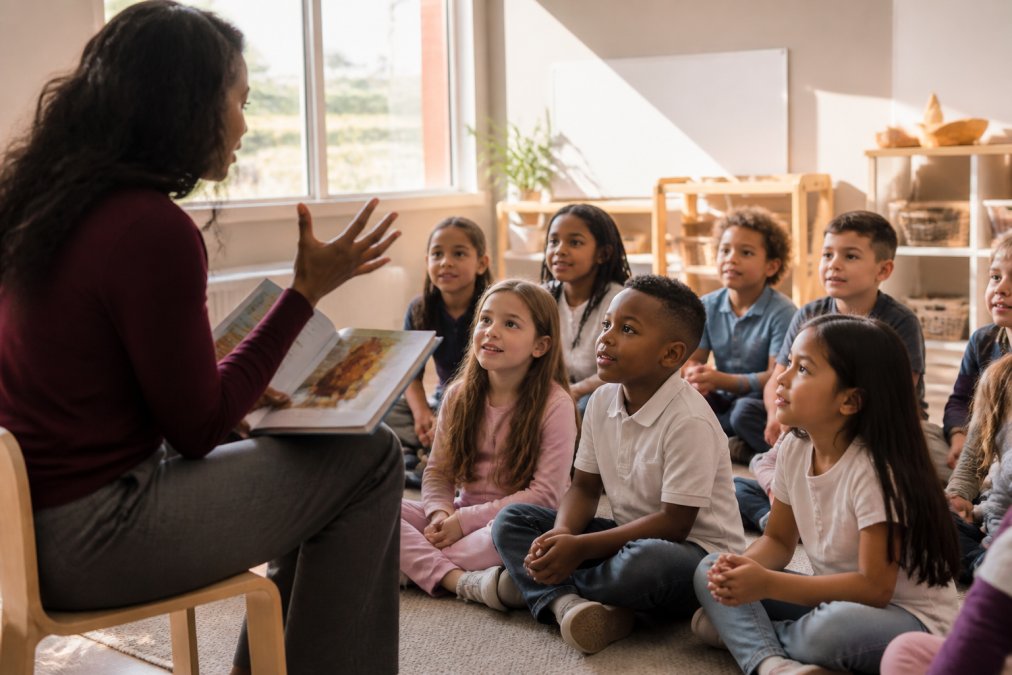
Effective storytelling rests on clarity and pacing. Avoid over-embellishing with theatrical flourishes that distract from the narrative. Students need clear story structure where cause and effect are visible, stakes escalate, and resolution feels earned.
Use three-act structure: Act One establishes the protagonist and challenge (creating emotional investment), Act Two develops obstacles where learning content lives embedded in the struggle, Act Three delivers resolution that anchors the core concept as the solution.
Here's how to implement narrative-driven instruction in your classroom:
-
Identify the core concept you're teaching. Don't start with the story; start with what students need to understand. Is it a historical event, a scientific principle, a mathematical relationship, a literacy skill?
-
Create a protagonist facing a problem that requires that concept to solve. The protagonist should be relatable to your students, age-appropriate, facing challenges they recognize. The problem must make the concept necessary, not optional.
-
Build the plot so the learning content IS the solution path. Don't teach the concept first, then tell a story about it. Make the story the vehicle for discovering the concept. Students should feel like they're figuring it out alongside the character.
-
Use sensory details to anchor the narrative. Describe what the character sees, hears, and feels. This creates mental imagery that deepens memory encoding. "The explorer felt cold stone beneath her hands" is more memorable than "The cave was cold."
-
Pause for student prediction. At critical moments, stop and ask what students think will happen next. This shifts them from passive listeners to active problem-solvers. Their predictions engage them with the logic of the narrative and the content simultaneously.
-
Connect the resolution to the real world. After the story concludes, explicitly link what the character discovered to what students can now do or understand. "Just like the explorer used geometry to navigate the cave, we can use these same principles to solve real problems."
Watch for genuine engagement: Are students leaning forward? Do they predict outcomes? Do they ask questions showing thinking beyond the immediate story? These signals indicate whether your narrative structure works or needs pacing adjustments.
Treat storytelling as a craft that improves with practice. Record yourself and listen for momentum loss, over-explanation, or rushed resolution. Small pacing adjustments create significant engagement shifts.
Story-Driven Curriculum Examples Across Subject Areas
Story-based learning for elementary students works across every subject by matching narrative structure to content's logic.
In literacy instruction, embed comprehension work within stories where characters must understand texts to solve problems. A character decoding an ancient map teaches directional language; interpreting a mysterious letter teaches inference. Reading skills develop as tools the character needs, not abstract exercises.
In mathematics, story-driven curriculum makes abstract relationships concrete. A character building a structure needs geometry; planning a journey requires calculating distance and time; dividing resources requires fractions. Math drives the plot forward because the character's success depends on it.
Science instruction benefits from narrative because scientific thinking is fundamentally about cause-and-effect relationships. A character exploring an ecosystem must understand food chains; investigating weather patterns requires grasping system interactions. Scientific concepts become the rules governing the character's world.
History becomes engaging through narrative. Students follow characters navigating historical events and discovering how choices created consequences. A student following a character through the American Revolution understands not just what happened, but why it mattered, creating deeper historical understanding.
Digital Storytelling Tools for Elementary Students and Classrooms
Digital storytelling tools expand possibilities beyond traditional narratives. Interactive platforms allow students to engage at their own pace, make choices affecting outcomes, and see immediate consequences, transforming passive listening into active decision-making.
Platforms like Capite Universe offer story-driven learning worlds combining interactive lessons with captivating narratives. The digital environment enforces narrative logic, pacing, and educational scaffolding that keeps stories focused on learning rather than pure entertainment.
Digital tools adapt to individual learner needs in real time. If a student struggles, the narrative pauses and provides scaffolding; if a student grasps material quickly, the story accelerates. This differentiation becomes natural within digital environments.
Consider the Kids In Time Full Lesson from Capite Universe, which takes young readers on a journey through childhood across thousands of years. Students discover how children lived, learned, and played across different eras, from cave-clan helpers to future explorers. This isn't a history textbook with dates; it's an experiential exploration of human culture and social-emotional learning woven through narrative. Students develop empathy by seeing themselves in children from vastly different times and places.

The Kids Personalized Story Book App demonstrates personalization's power. When a child becomes the protagonist with their name and interests woven into the narrative, they're discovering and learning within the story, not observing from outside.
Digital tools also enable what's called multimodal learning, combining text, imagery, sound, and interaction. A student might read narrative text, see illustrations that reinforce concepts, hear audio that brings scenes to life, and make interactive choices that advance the plot.
Building Classroom Community Through Narrative-Based Instruction
One of the most underestimated benefits of story-based learning for elementary students is its capacity to build classroom community. Shared narratives create common ground. When an entire class follows the same character through challenges, celebrates the same discoveries, and discusses the same themes, they develop collective understanding and mutual investment.
Common Mistakes Teachers Make With Story-Based Learning
The most prevalent mistake is confusing story-based learning for elementary students with storytelling entertainment. Teachers sometimes add elaborate narratives that feel engaging but don't actually connect to learning objectives. The story becomes the point rather than the vehicle. Students enjoy the entertainment but don't develop the intended skills or understanding.
Frequently Asked Questions
What is story-based learning and how does it differ from traditional instruction?
Story-based learning weaves academic content into narratives that students experience rather than simply memorize. Instead of reading a textbook passage about the Civil War, students follow a character's journey through that era. This narrative-based instruction activates emotional engagement and creates stronger neural pathways for memory. Traditional instruction often separates facts from context, while story-based learning integrates them, making abstract concepts concrete and relatable for elementary learners.
Can story-based learning actually improve reading skills and academic performance?
Yes. When students engage with narrative-driven instruction, they encounter vocabulary in meaningful context, practice comprehension strategies naturally, and build fluency through repeated exposure to engaging text. Story-based learning also develops critical thinking by requiring students to predict outcomes, analyze character motivations, and connect plot events to real-world concepts. Students show stronger knowledge retention because emotional engagement creates lasting memories, facts embedded in stories stick far longer than isolated facts.
How do I implement storytelling techniques for teachers in my classroom when I'm already following a set curriculum?
Story-based learning integrates into existing curricula by reframing standard lessons. For a math unit on fractions, create a scenario where a character must divide resources fairly. For science, follow an explorer discovering ecosystems. You don't replace your curriculum; you layer narrative structure onto it. Start with one subject area, practice storytelling techniques, and expand. Many teachers find that narrative-driven instruction actually saves time because students engage deeper and require less re-teaching.
What digital storytelling tools for elementary students are most effective for home and classroom use?
Effective tools combine engaging narratives with learning outcomes. Capite Universe offers story-driven content like Wings in Time ($7.99), which teaches aviation history through Bo's time-traveling adventure, and Kids In Time ($7.99), which builds empathy and cultural understanding across historical eras. The Kids Personalized Story Book App ($7.99) lets you create custom adventures starring your child. These tools work because they blend immersive storytelling with structured learning objectives, keeping students engaged while building reading and critical thinking skills without excessive screen passivity.


