How to Teach Phonics Through Stories: A 2026 Guide

Table of Contents
- Step 1: Build a Sound Warm-Up Before You Read
- Step 2: Choose Decodable Books for Phonics Practice
- Step 3: Match Phonics Features to the Story Text
- Step 4: Use Interactive Storytelling to Reinforce Letter-Sound Correspondence
- Phonics Story Lesson Plans: A Week-Long Template
- Phonics Activities for Kindergarten and Early Elementary
- How Long Does Narrative Learning Take to Work?
- Differentiation and Assessment: Tracking Progress Without Losing the Story
- Frequently Asked Questions
Last Updated: September 13, 2026
Step 1: Build a Sound Warm-Up Before You Read
Most parents open a book, point at a word, and hope the letters stick when they teach phonics. They rarely do. Before you teach phonics through stories, spend three to five minutes on a sound warm-up. This primes phonological processing so the reading that follows actually lands.
A sound warm-up is a short, spoken activity that activates the phonemes your child will meet in the story. No letters yet, just sounds.
Try this sequence:
- Say three words from the book aloud ("cat, cap, can") and ask which sound repeats
- Have your child segment one word into its individual sounds ("/c/ /a/ /t/")
- Practice one digraph or blend you know appears on the next page
The National Center on Improving Literacy's family guidance confirms that phonemic awareness is the strongest early predictor of later reading success. Warm-ups build it in minutes a day.
Step 2: Choose Decodable Books for Phonics Practice
The right book does half the teaching for you. Decodable books for phonics control the text so your child can actually sound out most words using letter-sound correspondence they already know.
Look for these markers:
- A high ratio of words that follow the phonics patterns you've taught
- Limited sight words that break the rules
- Clear, simple sentences with strong picture support
- A short list at the back showing which sounds the book targets
A common mistake is choosing a beautiful picture book with rich vocabulary and hoping phonics happens anyway. It won't. Those books build comprehension and print awareness, but they don't give beginning readers enough decodable repetition to build word recognition.
At Capite Universe, our story-driven lessons pair narrative with controlled vocabulary, so children practice decoding inside a story they want to finish rather than on a worksheet.
Step 3: Match Phonics Features to the Story Text
Before reading, scan two or three pages and circle the phonics features you want to target. This is the step most guides skip, and it's the one that separates a reading lesson from story time.
Match the text to what your child has learned:
- Short vowel patterns in simple CVC words ("sun," "map," "hop")
- Consonant blends at the start of words ("stop," "clap," "frog")
- Digraphs like "sh," "ch," and "th"
- Long vowel patterns and silent-e words once basics are solid
Using Illustrations to Support Decoding
Illustrations aren't decoration. They're a decoding scaffold. When your child stalls on a word, the picture gives meaning that supports the sound-out attempt instead of replacing it.
Point to the image and ask, "What's happening here?" Then return to the word. This is contextual learning at work: the meaning and the sounds reinforce each other.
Step 4: Use Interactive Storytelling to Reinforce Letter-Sound Correspondence
Reading aloud is passive if your child just listens. Interactive storytelling turns them into a participant. Pause, ask, and let them handle the sounds.
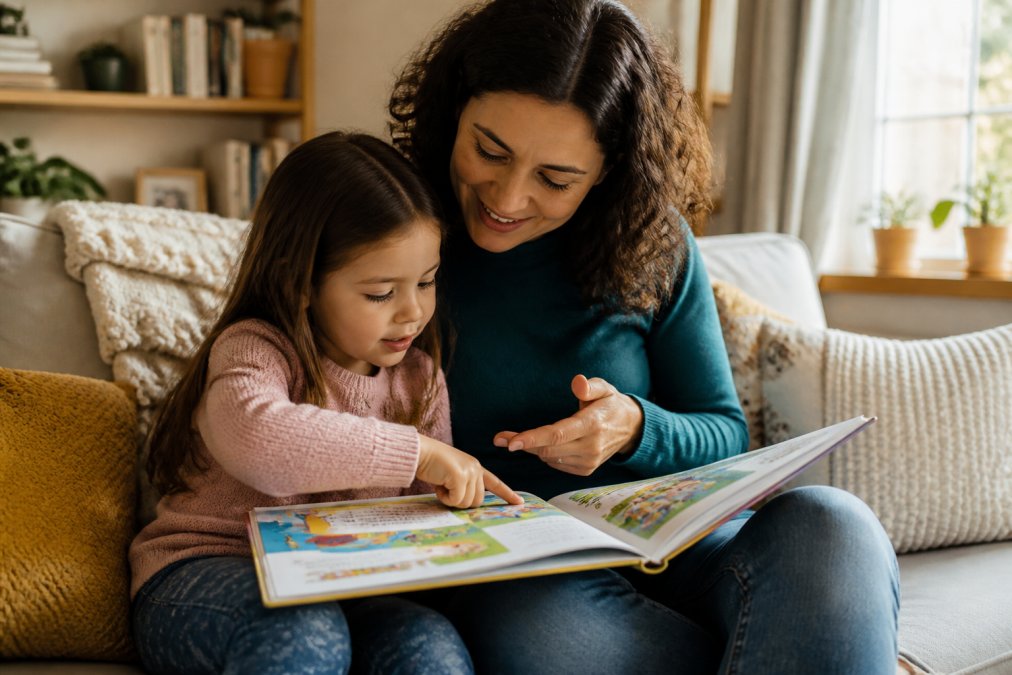
Techniques that work:
- Sound spotting: "Every time you hear the /s/ sound, tap the page"
- Echo reading: You read a line, they read it back
- Word hunts: "Find three words on this page that start with the 'ch' sound"
- Character voices: Give each character a sound pattern to practice
The goal is repeated exposure to graphemes and their phonemes without it feeling like drilling. Children who encounter a sound many times across different words build the orthographic mapping that makes reading automatic.
Phonics Story Lesson Plans: A Week-Long Template
Structure beats improvisation. A simple weekly plan keeps you consistent and lets you see what's working. Here's a template you can reuse with any decodable book.
| Day | Focus | Activity | Time |
|---|---|---|---|
| Monday | Sound warm-up | Introduce the week's target sound, segment 5 words aloud | 5 min |
| Tuesday | Decoding | Read the book, child sounds out target words | 15 min |
| Wednesday | Reinforcement | Word hunt and rhyming game with the target pattern | 10 min |
| Thursday | Fluency | Echo reading, then child reads a page solo | 15 min |
| Friday | Review | Re-read favorite page, celebrate progress, note wins | 10 min |
Teacher and Parent Script Templates
A script removes the guesswork. Use these exact prompts.
Sound warm-up script:
"Today we're listening for the /ch/ sound. I'll say a word. If you hear /ch/, give me a thumbs up. Ready? chair... cat... cheese... church."
Decoding prompt:
"This word is tricky. Let's use our sounds. What's the first sound? Good. What's next? Now blend them together. You've got it."
Comprehension check:
"You read that sentence. What just happened in the story? Why do you think the character did that?"
Capite Universe's printable activities and guided stories come with this kind of structure built in, so you're not writing scripts from scratch each week.
Phonics Activities for Kindergarten and Early Elementary
Phonics activities for kindergarten should be short, playful, and repeated. Attention spans are brief, so frequency beats duration every time. The mistake most guides make is handing you one generic list and stopping there. What actually moves a child forward is matching the activity to the learner and knowing what a successful rep looks like.
Start with the core set, then use the differentiation notes below to tune each one.
- Rhyming games: "Cat, hat, bat. Which one doesn't belong?" builds phonemic awareness before letters enter the picture.
- Sound sorting: Sort picture cards by beginning sound into labeled cups. Keep the cups to three or four sounds at a time so the task stays winnable.
- Letter-sound hopscotch: Draw letters on the ground, child hops and says the sound. Movement anchors the sound to the body.
- Story re-tell: After reading, have your child retell it using three target words. This bridges decoding and comprehension.
- Word building: Use letter tiles to swap one sound and make a new word ("cat" to "hat"). This is the single most efficient activity for building orthographic mapping (pubmed.ncbi.nlm.nih.gov).
For older early-elementary readers, add syllable clapping and blending two-syllable words. The same playful format works; the words just get longer.
Differentiating the Same Activity for Different Learners
One activity list won't serve every child, and running separate curricula isn't realistic for a parent or a single classroom teacher. Adjust the same task instead.
For struggling readers: pre-teach the target sound the day before, cut the card set in half, and let the child sort with the sound already modeled aloud. Reduce the number of choices before you reduce the difficulty of the sounds.
For students learning English as a second language: pair every sound with a picture and a physical gesture, and avoid activities that depend on vocabulary the child hasn't acquired yet. Sound sorting with picture cards works better than word-only tasks because the image carries the meaning while the sound carries the phonics.
For children with dyslexia or persistent decoding difficulty: lean heavily on multisensory routines, trace the letter in sand or on a textured surface while saying the sound, build the word with tiles before writing it, and keep sessions to five to seven minutes with a clear stopping point. Structured, cumulative review matters more than novelty here; repeat the same sound across many sessions rather than rotating quickly.
For advanced readers: swap in two-syllable words, ask inference questions about the story, and let them read the target page aloud to a younger sibling. Teaching a sound to someone else is one of the strongest consolidation activities available.
A Quick Check That the Activity Worked
You don't need a formal test. Use a one-minute check at the end of each session: show three words containing the target sound and one that doesn't, and ask the child to pick out the odd one. If they get it right without prompting, the sound is moving toward automatic. If they need a reminder, repeat the same activity tomorrow rather than introducing a new one. Track this in a simple three-column note, sound, date, independent or prompted, and you'll see the pattern within two weeks.
How Long Does Narrative Learning Take to Work?
Parents ask this constantly, and the honest answer is that consistency matters more than calendar time. But "it depends" isn't useful on its own, so here is what most practitioners actually see, and how to tell whether your specific child is on track.
Realistic Pacing Benchmarks
A common pattern for families doing daily fifteen-minute story sessions:
- Weeks 1-2: The child recognizes the target sound in isolation and can pick it out of a spoken word. Decoding in the book is still heavily prompted.
- Weeks 3-6: The child sounds out target words in the story with occasional help. This is where most parents see the first real shift in confidence.
- Weeks 6-12: The child reads target words in a new book without prompting. This is the milestone that matters, not fluency in the book you've reread ten times, but transfer to unfamiliar text.
- Months 3-9: Sounds accumulate. A child who started behind may need a full school year of steady practice before the pattern feels automatic.
If your child reads the same decodable pattern fluently in a brand-new book, that's the signal to move to the next sound. Move too early and you'll see guessing; move too late and you'll see boredom.
How to Measure Whether It's Working
This is the step most guides skip entirely, and it's the one that tells you whether to keep going or change approach. You don't need a formal assessment, you need a running record.
Keep a simple log with four columns: date, sound practiced, words read independently, words that needed prompting. Once a week, review it and ask three questions:
- Is the list of independently decoded words growing? If yes, the approach is working regardless of how slow it feels day to day.
- Is the same sound prompting help across multiple sessions? If a sound has needed prompting for more than two weeks, back up and reteach it in isolation before returning to the story.
- Is comprehension keeping pace with decoding? A child who can sound out every word but can't retell the page needs comprehension support, not more phonics.
A useful accuracy target for beginning decodable reading is roughly 90-95% of words read correctly with support (readingrockets.org). Below that, the text is too hard and frustration will outpace learning. Above it for several sessions in a row, the text is too easy and it's time to level up.
When to Change the Plan
Progress is uneven, plateaus followed by jumps are normal, not a sign of failure. But three patterns warrant a change: a plateau lasting more than three weeks with no new independently decoded words, increasing resistance or avoidance at story time, or a child who decodes well but consistently misses meaning. The first two usually mean the text is too hard; the third means the balance between decoding and comprehension needs to shift.
Track progress weekly, not daily. Day-to-day variation is noise. The weekly trend is the signal, and it's the only reliable way to know whether story-based phonics is actually moving your child forward.
Differentiation and Assessment: Tracking Progress Without Losing the Story
One lesson plan won't fit every child, and that's fine. Differentiation means adjusting the same story for different learners rather than running separate curricula.
For struggling readers: pre-teach the target sound, reduce the page count, and read the story twice before expecting solo decoding.
For advanced readers: ask inference questions, introduce longer vowel patterns, and let them read to a younger sibling.
For diverse learners: pair sound work with movement, touch, or song. Multisensory approaches reach children who don't absorb through listening alone.
Track progress with a simple running record. Note which sounds your child decodes independently, which need prompting, and which they miss. Review it weekly. This is assessment that serves the story instead of interrupting it.
Families and teachers who want structured, story-driven phonics practice without building every lesson from scratch.
Building a phonics routine that children actually look forward to is the hard part. Capite Universe makes it easier with a story-driven learning world where interactive lessons, printable activities, and teacher-approved guided stories turn decoding practice into an adventure kids want to continue. Our platform keeps children engaged through a bigger universe narrative while developing essential reading and critical thinking skills. Get started with Capite Universe and turn story time into real reading progress.
Frequently Asked Questions
What are some good stories to teach phonics?
Choose decodable books that align with the phonics features your child is learning. For beginning readers, look for texts with short vowels, consonant-vowel-consonant words, and common digraphs like sh, ch, and th. Story-driven platforms such as Capite Universe offer narrative lessons that embed these patterns into engaging adventures, so children practice decoding while following a plot. Avoid predictable or leveled readers that encourage guessing from pictures rather than sounding out words.
How long does narrative learning take to work for phonics?
Most children show measurable gains in letter-sound correspondence and word recognition after four to six weeks of consistent story-based phonics instruction, provided sessions happen three to five times per week. Fluency and comprehension improvements typically emerge over two to three months. Progress depends on the child's starting point, the explicitness of instruction, and whether practice includes segmenting, blending, and cumulative review. Track decoding accuracy weekly to see whether the approach is working.
How do you integrate phonics into daily reading routines?
Start each read-aloud with a two-minute sound warm-up focused on the target phonemes. During reading, pause at words that contain the phonics feature you are teaching and have the child segment and blend the sounds. After reading, play a quick rhyming or word-building game using words from the story. This three-part routine, warm-up, guided decoding during reading, and reinforcement after, takes about fifteen minutes and fits into any daily schedule.
Can story-based phonics work for struggling readers or diverse learners?
Yes, when instruction is explicit and scaffolded. Struggling readers benefit from extra practice with phonemic awareness and cumulative review before new phonics features are introduced. Use multisensory techniques such as tracing letters in sand or building words with magnetic tiles while narrating the story. For diverse learners, adjust pacing and repeat sound warm-ups as needed. Capite Universe lessons include printable activities that support this kind of differentiation at home or in the classroom.


