Engaging Phonics Activities for 7 Year Olds: 7 Fun Ideas

Table of Contents
- Why Phonics Still Matters at Age 7
- 7 Engaging Phonics Activities for 7 Year Olds to Try Today
- Multisensory Phonics Activities That Stick
- How to Teach Phonics to Struggling Readers
- Phonics Games for 2nd Graders: Screen-Free and Digital Balance
- How to Track Progress and Differentiate Instruction
- Frequently Asked Questions
Last Updated: September 11, 2026
Why Phonics Still Matters at Age 7
Most seven-year-olds have cracked the basic code of reading, so parents assume phonics instruction is finished. It isn't. Seven is the year decoding turns into fluency, and fluency carries comprehension for the rest of school. This guide from Capite Universe walks through seven engaging phonics activities for 7 year olds you can run at home or in a classroom this week.
Phonics is the instructional approach that teaches readers how letters and letter combinations map to the sounds of spoken language. At seven, that mapping work shifts from single letters to phonics patterns: consonant digraphs, vowel teams, and the syllable structures that make longer words readable.
The stakes are practical. Children who still guess at unfamiliar words in second grade tend to avoid reading, and avoidance widens the gap faster than any single skill deficit. The National Center on Improving Literacy's family resource library outlines how decoding practice at home reinforces what structured literacy lessons build at school.

Most activity roundups hand you a list of games with no order, no skill target, and no way to tell whether the game is working. Below are seven activities mapped to specific skills, plus how to tell if your child is progressing.
7 Engaging Phonics Activities for 7 Year Olds to Try Today
Each activity targets a different decoding or encoding skill, takes ten to twenty minutes, and needs materials you likely already own. Start with word chaining and digraphs, then rotate in the rest across the week.
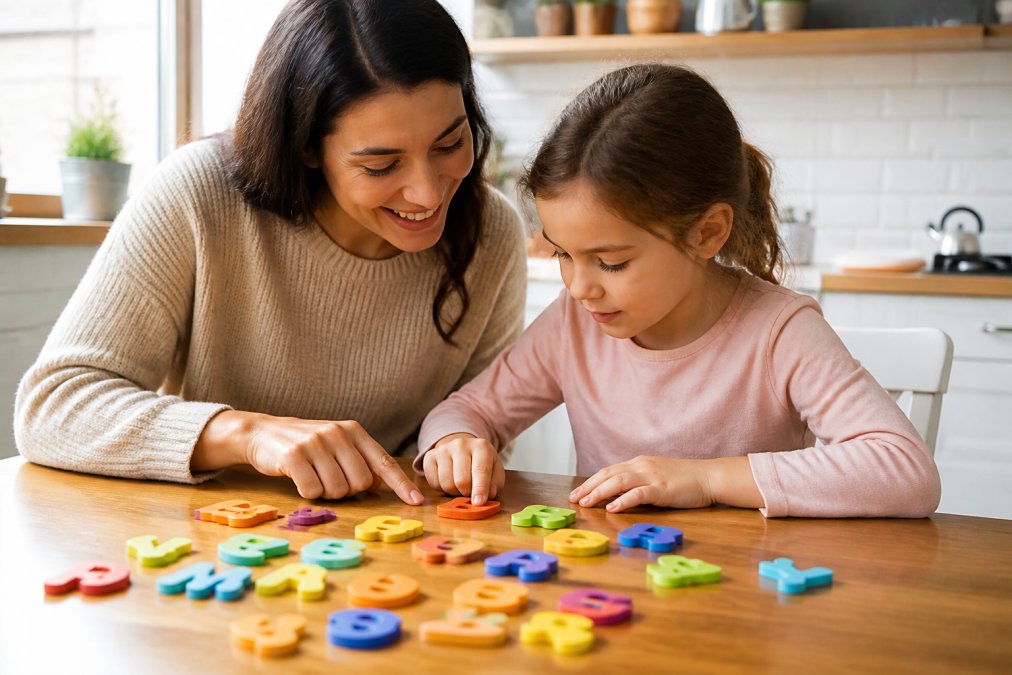
1. Word Chaining with Letter Tiles
Word chaining changes one sound at a time to build a new word: cat, hat, hot, hop, shop. It forces attention onto individual phonemes rather than whole-word guessing.
Lay out tiles for the starting word. Say the next word aloud and have your child swap exactly one tile to make it. Chain eight to ten words per round.
Chaining exposes gaps fast. If your child swaps the wrong tile twice in a row, the problem is usually a specific sound, not the game.
2. Consonant Digraph Hunt Around the House
Consonant digraphs are two letters that make one sound: sh, ch, th, wh, ck (readingrockets.org). A hunt turns recognition into a physical search.
Give your child a sticky-note pad and a target digraph. They label every object in the room containing it: chair, shelf, thermos, clock. Ten minutes, one digraph.
- sh: shelf, shirt, dish, brush
- ch: chair, chalk, lunchbox, watch
- th: thermometer, bath, cloth, toothbrush
3. Vowel Team Sort and Race
Vowel teams are letter pairs like ai, ea, oa, and oo that make one vowel sound (readingrockets.org). Sorting them builds pattern recognition that transfers to unfamiliar words.
Write twenty words on index cards, mix them, and time your child sorting them into vowel-team piles. Beat the previous time, not a sibling.
4. Phonics Songs and Clap-the-Syllable Games
Clapping syllables builds phonological processing, the awareness of sound units inside words. Pair it with a phonics song for auditory repetition without a worksheet.
Pick a word like butterfly. Clap but-ter-fly while saying each part. Move to longer words: elephant, computer, basketball. Then reverse it: clap a pattern and ask your child to name a matching word.
5. Printable Phonics Worksheets and Decodable Mini-Books
Printable resources give you a record of what your child can decode independently. A decodable text uses only the phonics patterns a child has already learned, so success is earned rather than guessed.
Capite Universe builds printable activities and guided stories into its lesson packs, which is useful when you want structured material without assembling it yourself.

6. Interactive Digital Phonics Tools
Interactive digital tools add immediate feedback: a wrong answer gets corrected in the moment, which is hard to replicate with paper. Use them as a supplement, twenty minutes at a time.
Balance matters here. A tool that reads aloud to your child is entertainment; a tool that makes your child produce sounds is instruction. Choose the second kind.
7. Dictation and Spelling Pattern Journals
Dictation reverses decoding into encoding. You say a sentence, your child writes it, and the spelling errors reveal which patterns need review.
Keep a dedicated journal. After each dictation, have your child write the corrected word three times and note the pattern beside it, for example "rain, ai says /ā/."
| Activity | Skill Targeted | Time Needed | Frequency |
|---|---|---|---|
| Word chaining | Phoneme manipulation | 10 min | 3x weekly |
| Digraph hunt | Consonant digraphs | 10 min | 2x weekly |
| Vowel team sort | Vowel patterns | 15 min | 2x weekly |
| Songs and clapping | Syllabication | 5 min | Daily |
| Worksheets and mini-books | Decodable reading | 20 min | 3x weekly |
| Digital tools | Fluency and feedback | 20 min | 2x weekly |
| Dictation journal | Spelling patterns | 15 min | 2x weekly |
Multisensory Phonics Activities That Stick
Multisensory instruction pairs seeing, saying, hearing, and touching the same sound, giving the brain multiple retrieval routes. For a seven-year-old, a word isn't just a shape on paper, it's a sound they produced, a letter they traced, and a pattern they placed.
This matters at seven because of the shift from decoding to fluency. A child who consciously recalls that ai says /ā/ reads slowly; one who has traced, said, and sorted that pattern retrieves it automatically. Multisensory repetition moves a pattern from effortful to automatic.
Four Multisensory Routines, With Dosage
- Sand or shaving-cream tracing. Spread a thin layer on a cookie sheet. Your child traces the letter or letter team while saying its sound aloud. Ten to fifteen repetitions per pattern, two or three patterns per session. The arm motion plus the spoken sound is the point, tracing silently loses half the benefit.
- Magnetic letters on a cookie sheet. Build a word, read it, then change one letter to make a new word. This is word chaining with a tactile component, and it works well for children who resist writing. Eight to ten words per round.
- Finger-tap blending. Tap one finger per sound as your child blends a word: /sh/ /o/ /p/ on three taps. This gives a physical anchor for phoneme counting, which is the skill behind both spelling and decoding.
- Air writing with a full arm motion. Your child writes a spelling word in the air with a straight arm while saying each letter name and then the whole word. Best used for irregular words that don't follow a pattern, said, were, because, where the goal is memory, not decoding.
Match the Routine to the Error, Not the Age
A common mistake is treating multisensory work as a reward for younger kids or a warm-up before "real" phonics. It works best when it targets the exact pattern your child is missing.
- If your child drops sounds when blending (sop for stop), use finger-tap blending and magnetic letters.
- If your child reads sh as /s/ and /h/ separately, use sand tracing plus saying the digraph sound.
- If your child spells phonetically but misses irregular words, use air writing and dictation.
What Multisensory Practice Is Not
It is not a substitute for decodable text. Tracing and tapping build the sound-symbol link, but the link only becomes reading when your child applies it to connected text. Pair every multisensory session with five to ten minutes of a decodable passage using the same pattern. Without that step, the skill stays stuck at the worksheet level.
It is also not a reward. If multisensory work only happens after the "real" lesson, children learn to treat it as optional. Put it first, keep it short, and treat it as the lesson.
How to Teach Phonics to Struggling Readers
Struggling readers need less variety, not more. Rotate two or three activities consistently and keep the pattern set narrow until it's automatic.
The sequence that works: review a known pattern, introduce one new pattern, practice it in isolation, then apply it in a decodable text. Skip the application step and the skill stays stuck at the worksheet level.
What most guides miss is pace. A child who is behind doesn't need harder material; they need the same material in smaller steps with more repetition. If a pattern isn't automatic after a week, slow down rather than moving on.
Phonics Games for 2nd Graders: Screen-Free and Digital Balance
Second grade is where phonics games for 2nd graders do the most work, because reading volume increases sharply and the gap between fluent and effortful readers widens. The question isn't screen-free versus digital; it's which one your child is actively producing in.
Most articles either list apps or list printables. Neither tells you when to use which. Here's a framework.
The Production Test
Before you hand your child a tool, ask one question: does this make my child produce the sound, or does it produce the sound for them?
- A tool that reads a word aloud and asks your child to pick the matching picture is receptive. Useful for vocabulary, weak for phonics.
- A tool that shows a word and asks your child to say it, segment it, or spell it is productive. This is where phonics gains happen.
- A worksheet where your child writes the missing digraph is productive. A worksheet where your child circles a picture is receptive.
Apply the test to every activity in this article. The productive ones build decoding; the receptive ones build familiarity.
A Weekly Balance That Holds Up
A reasonable split for a seven-year-old is four screen-free sessions to one digital session per week, with the digital session capped at twenty minutes. That ratio reflects two trade-offs:
- Screen-free wins on retention. Tracing, building, and writing engage motor memory, which digital tapping does not. A pattern practiced with a pencil or tile sticks longer than one practiced with a tap.
- Digital wins on feedback speed. A wrong answer gets corrected in the moment, which is hard to replicate with paper. That immediacy is genuinely useful for a child who is guessing rather than decoding.
Use digital for the pattern your child is currently getting wrong, and screen-free for the pattern you want to make automatic.
When to Drop the Digital Session Entirely
There are three situations where the digital session should come out of the rotation:
- Your child is guessing. If they tap answers quickly without sounding out, the tool is rewarding speed over decoding. Go back to screen-free chaining and dictation.
- Your child can't explain the pattern. If they can sort ai and ea words on screen but can't tell you what ai says, the tool is teaching recognition, not phonics.
- The session runs past twenty minutes. Fatigue turns productive practice into guessing. Stop at twenty even if the tool offers more.
Bridging Screen and Paper
The strongest setup uses the same pattern in both formats within the same week. Sort vowel teams on paper Monday, then use a digital tool on the same vowel teams Wednesday. The digital session becomes a check on whether paper practice transferred, not a separate curriculum.
If you want the digital portion to be story-driven rather than passive, Capite Universe delivers interactive lessons and printable activities together, so the same narrative carries from screen to paper.
How to Track Progress and Differentiate Instruction
Assessment doesn't require a formal test. A ten-word dictation once a week gives you everything you need.
Score three things: how many words were spelled correctly, which pattern caused the errors, and whether your child self-corrected. Track these in the same journal you use for dictation.
Then differentiate:
- Struggling readers: repeat the same pattern for two weeks, add more multisensory practice, use shorter decodable texts
- On-track readers: introduce vowel teams and multisyllable words, increase text length
- Advanced readers: move to orthographic mapping of irregular words and spelling patterns, and add dictation with longer sentences
A common mistake is advancing a child because they finished the worksheet. Finished is not automatic. If your child still sounds out a word letter by letter, that pattern needs more time.
Seven-year-olds don't need more phonics games; they need the right ones, repeated consistently, with a way to see what's working. That's the gap Capite Universe was built to close: a story-driven learning world with interactive lessons, printable activities, and guided stories that carry the same narrative from screen to paper, all teacher approved and instantly accessible. If you're tired of assembling materials from five different sources, get started with Capite Universe and give your child one structured world where reading practice feels like an adventure.
Frequently Asked Questions
How can I help my 7-year-old improve phonics skills at home?
Start with 10-15 minutes of daily practice using word chaining, letter tiles, and decodable texts. Focus on one phonics pattern at a time, like consonant digraphs or vowel teams. Use multisensory phonics activities that involve touch, movement, and sound. For example, have your child trace letters in sand while saying the sound, or build words with magnetic tiles. Consistency matters more than length. Pair short sessions with story-driven digital lessons to keep engagement high.
What are the most effective phonics activities for 7-year-olds?
The most effective activities combine phonemic awareness, decoding, and spelling. Word chaining, where children change one letter to make a new word, builds decoding and blending skills. Sorting vowel teams and consonant digraphs reinforces phonics patterns. Dictation strengthens spelling patterns and orthographic mapping. Printable phonics worksheets and decodable texts give structured practice. Interactive digital phonics tools add variety and immediate feedback. Rotate activities to cover segmentation, blending, and fluency.
How do I know if my 7-year-old needs extra phonics support?
Watch for signs like guessing at words instead of sounding them out, avoiding reading aloud, or struggling with letter sounds and blending. If your child cannot decode simple CVC words or read grade-level decodable texts, they may need extra support. A quick assessment of phonemic awareness and phonics patterns can help. Consult your child's teacher for a structured literacy evaluation. Early intervention with multisensory phonics activities and explicit instruction makes a big difference.
What is the difference between phonemic awareness and phonics?
Phonemic awareness is the ability to hear and manipulate individual sounds (phonemes) in spoken words, like identifying the first sound in 'cat.' Phonics is the connection between those sounds and written letters (graphemes). Phonemic awareness is auditory; phonics is visual and auditory. Both are essential for reading. At age 7, children should practice both: clapping syllables, blending sounds orally, and then mapping those sounds to letters in print. Together they build decoding and fluency.


