How Do You Create a Cozy Home Reading Nook?

Last Updated: November 4, 2026
Quick Summary
To create a cozy home reading nook, start with a corner that has a wall behind you and natural light, then add a chair that supports 30+ minutes of sitting, two light sources, soft textiles, and book storage sized to the space. Solve seating and lighting before buying decor, because a pretty corner with a hard chair gets used twice.
- Pick a corner away from busy paths, and sit there ten minutes at your family's usual reading time to test traffic.
- For adults, look for a seat height of about 17 to 19 inches and a seat depth of 20 to 22 inches.
- Use two separate fixtures: a bright task lamp beside the chair and a soft ambient glow for mood.
- Layer an area rug, a knit blanket, and two or three throw pillows, sticking to two or three colors.
- A single floating shelf about 24 to 36 inches wide holds roughly 20 to 30 picture books.
Table of Contents
- What You'll Need Before You Start Your Reading Nook
- Step 1: Pick the Right Spot for Your Cozy Home Reading Nook
- Step 2: Choose Seating That Supports Long Reading Sessions
- Step 3: Layer Lighting for Ambiance and Task Work
- Step 4: Add Soft Textiles, Throws, and Cushions
- Step 5: Solve Book Storage and Small-Space DIY
- How to Create a Cozy Reading Nook for Kids
- How to Improve Reading Comprehension Skills in Your Nook
- Frequently Asked Questions
What You'll Need Before You Start Your Reading Nook
Building a cozy home reading nook takes less space and less money than most people expect. A corner, a comfortable chair, and a good light get you most of the way there. Many parents want a quiet spot where their kids will actually choose to read, and the nook is often the first step.
A few honest notes before you shop. The biggest mistake is buying decor before you solve seating and light. A pretty corner with a hard chair gets used twice. A plain corner with the right chair gets used every night.
The Five-Part Nook Checklist
Here is the short version of everything this guide covers:
- A spot with a wall behind you and some natural light
- A chair or cushion that supports 30+ minutes of sitting
- Two light sources: one bright for reading, one soft for mood
- A throw, two or three pillows, and a rug
- One basket or shelf for books, sized to the space
Work through the five steps below in order. Each one builds on the last.
Step 1: Pick the Right Spot for Your Cozy Home Reading Nook
Start with location, because it decides everything else. The best spot is a corner with one or two walls, away from the busiest path through your home, and near a window if you can manage it.
Corner use matters more than square footage. A corner gives you two walls for shelves and art, cuts visual noise, and feels enclosed without a single nail. That enclosed feeling is most of what makes a nook feel cozy.
Corner Use and Natural Light
Natural light is free ambiance, so use it first. Put the chair where morning or late-afternoon sun reaches it, but angle it so glare does not hit the page. If the window is too bright, a sheer curtain fixes it for a few dollars.
What most guides miss is the traffic test. Sit in your chosen corner for ten minutes at the time of day your family usually reads. If people walk through it, it is a hallway, not a nook. Pick somewhere else.
Step 2: Choose Seating That Supports Long Reading Sessions
Seating is the one place not to cut corners. A reading chair needs a back high enough to lean on, arms to rest a book, and a seat deep enough that you are not perched. An oversized chair or a small loveseat works well. A beanbag or floor cushion works for kids.
Ergonomics matter here. For long sessions, feet should rest flat on the floor or a footstool, and the book should sit near chest height so the neck stays neutral.
Fit the Chair to the Reader
Measure before you buy. For an adult, look for a seat height of about 17 to 19 inches so both feet land flat, a seat depth of 20 to 22 inches so the back of the knees clears the cushion edge, and a back that reaches at least mid-shoulder blade. For a child ages 6 to 10, a seat height around 12 to 14 inches and a depth around 14 inches keeps them from sliding forward.
Armrests should sit at roughly elbow height when the reader is seated, so the forearms rest without hunching. If the chair has no arms, add a small side table at elbow height for the book hand.
Support the Lower Back and Neck
A lumbar pillow placed in the small of the back can support the spine during a long chapter. A book stand or wedge pillow raises the page to chest height so the neck stays neutral instead of dropping toward the lap.
Watch out: a chair that feels fine for ten minutes can cause back and neck ache after forty, so test any chair with a full chapter before you commit to it.
If long reading sessions leave your neck tight, a heated neck and spine massager can turn a short reading break into real recovery time.

Here are the seat measurements the article gives for fitting a chair to the reader.
| Reader | Seat height | Seat depth | Note |
|---|---|---|---|
| Adult | About 17 to 19 inches | 20 to 22 inches | Back reaches at least mid-shoulder blade |
| Child ages 6 to 10 | Around 12 to 14 inches | Around 14 inches | Keeps them from sliding forward |
| Ages 11 to 14 | Not stated | Not stated | Usually fit an adult small chair or deep beanbag |
Step 3: Layer Lighting for Ambiance and Task Work
Two lights work better than one bright light for most reading corners. Task lighting is the bright, focused light that makes print easy to read. Ambient lighting is the soft background glow that makes the corner feel calm.
For task lighting, a floor lamp or a clamp lamp placed beside the chair and slightly behind your shoulder works best. For ambiance, a small table lamp, a string of warm bulbs, or a diffuser with a soft night light does the job.
Kids Personalized Story BOOK App →
A white noise and aroma diffuser adds a third layer: sound and scent. Eight white noise settings help block household noise, and the soft glow doubles as mood lighting.

Step 4: Add Soft Textiles, Throws, and Cushions
Textiles are what turn a chair in a corner into a room. Layer three things: an area rug underfoot, a knit blanket over the chair arm, and two or three throw pillows in different sizes.
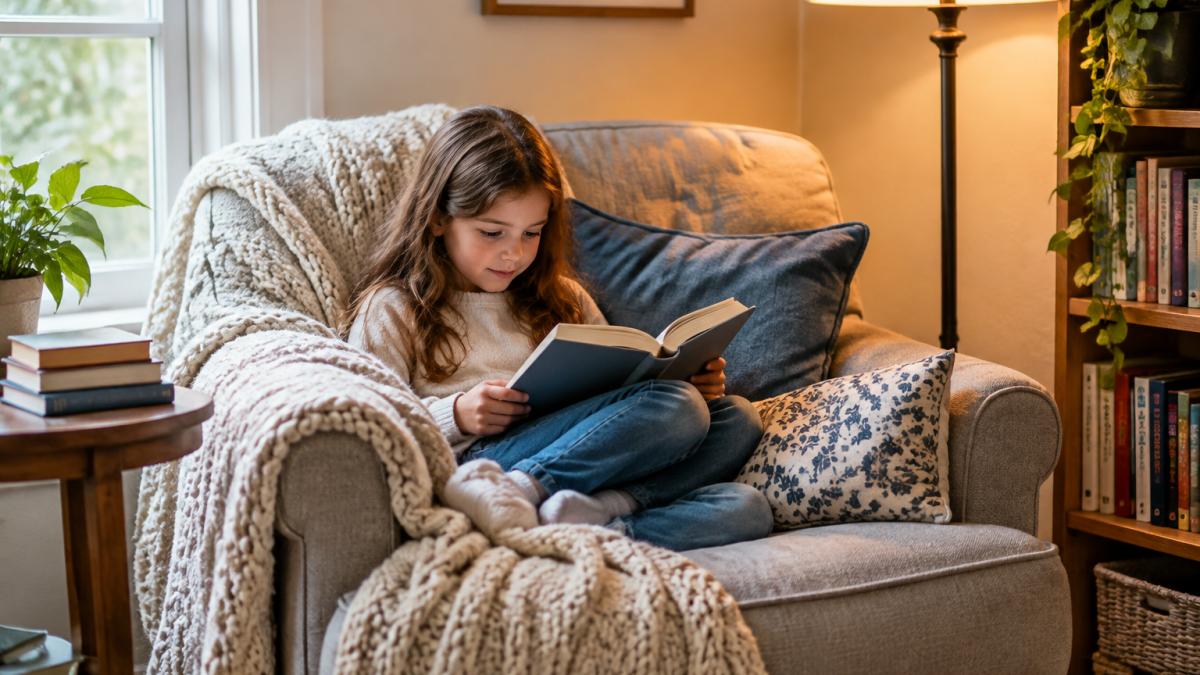
Stick to two or three colors so the space feels curated rather than cluttered. A common mistake is buying five patterns that fight each other. Pick one pattern, one solid, and one texture. That rule alone keeps a small space calm.
Step 5: Solve Book Storage and Small-Space DIY
Book storage should match the nook, not overwhelm it. In a small space, a single wall shelf, a stackable crate, or a basket beside the chair holds enough. Rotate books seasonally so the shelf stays fresh and the collection stays manageable.
Size the Storage to the Space
A single floating shelf about 24 to 36 inches wide holds roughly 20 to 30 picture books or 15 to 20 chapter books. A basket beside the chair holds about 10 to 15 books and is easy for kids ages 6 to 10 to reach. A narrow bookshelf 11 to 13 inches deep fits most hardcovers without jutting into the walkway. Keep the top shelf at or below eye level for the reader so they can see titles without climbing.
Space-saving ideas that work:
- A floating shelf above the chair
- A basket tucked under a side table
- A narrow bookshelf used as a room divider
- A wall-mounted magazine rack for current reads
- A stackable crate that doubles as a footstool
Build a Rotation System
Keep only the current favorites in the nook and store the rest elsewhere. A simple pattern is to swap the nook shelf every two to four weeks, pulling in books that match the season or a current interest. This keeps the space from overflowing and gives kids a reason to revisit the nook.
Quiet the Corner with Soft Surfaces
Acoustics matter too. A rug, heavy curtains, and upholstered seating can absorb echo, which can make a corner feel quieter.
Watch out: a shelf packed to the ceiling over the chair can feel heavy and cast shadow on the page, so leave breathing room above the reader's head.
How to Create a Cozy Reading Nook for Kids
Build a kids' nook at their height, not yours. A floor cushion, a low shelf they can reach, and a clip-on light beat an adult chair they have to climb into. Add a small basket of books and let them choose what goes on the shelf.
Ages 6 to 10 do well with a beanbag, a soft rug, and one low shelf. Ages 11 to 14 usually want a chair, a small side table, and a bit of privacy, so face the nook away from the room's center.
The nook only pays off if it becomes a habit. For a structured way to build one, see our guide on creating a daily reading habit for 10-year-olds.
How to Improve Reading Comprehension Skills in Your Nook
A nook is a reading space first and a learning space second. Keep the nook free of screens and clutter so it stays a signal for focus. Ten to twenty quiet minutes a day in the same spot builds the habit faster than long weekend sessions.
For the comprehension side, our guides on improving reading comprehension skills and building reading and comprehending skills walk through methods you can pair with the nook.
Capite Universe is a story-driven learning world for kids ages 6 to 14. It offers immersive adventures that build reading, critical thinking, and creativity, with printable activities and teacher-approved lessons delivered instantly. Shop with Us to explore the collection.
Frequently Asked Questions
What are the essential elements of a cozy home reading nook?
Five elements do most of the work: a dedicated spot with minimal foot traffic, supportive seating you can sit in for 30 minutes or more, layered lighting that includes both a task lamp and softer ambient light, soft cushions and a knit blanket, and book storage within arm's reach. A small area rug helps define the space and absorbs sound. You do not need a large room. A corner of a bedroom or the end of a hallway works if the lighting and seating are right.
How do I build a reading nook in a small bedroom?
Use the corner between the bed and the window, and go vertical. A wall-mounted shelf or a narrow bookshelf keeps books off the floor, and a floor lamp takes up less space than a side table. Choose an oversized chair or a floor cushion instead of a full armchair and ottoman set. Keep the palette to two or three colors so the corner reads as intentional rather than cluttered. A single area rug defines the nook without adding furniture.
How can a reading nook help improve my child's reading comprehension skills?
A consistent, distraction-free spot makes it easier for a child to read for longer stretches, and sustained reading time is what builds comprehension. Pair the nook with a short routine: read together for 15 to 20 minutes, then ask two or three questions about what happened and why. Story-driven material gives kids something to retell, which is the same skill comprehension tests measure. Keep the nook free of screens so the time stays focused on text.
What lighting is best for a home reading corner?
You want two layers. A task light, such as an adjustable floor lamp or a clip-on reading light, should sit at shoulder height and point at the page rather than over the reader's head. Then add softer ambient light, like a small night light or a diffused lamp, so the contrast between the page and the room is not harsh. Position the nook to catch morning or late-afternoon natural light where you can, and avoid placing the chair with a window directly behind it.
Your nook is ready. The next step is filling it with stories your kids will ask for again. Capite Universe pairs the quiet corner with guided adventures across galaxies and ancient kingdoms, built to keep young readers engaged long after the first chapter. Get started with Capite Universe and turn a cozy corner into a daily reading habit.


