Gamified Learning and Long-Term Memory Retention

Last Updated: November 9, 2026
Quick Summary
Research on gamified learning and long-term memory retention is mixed: games reliably boost short-term performance, but those gains often fade within weeks. Retention depends on whether rewards attach to correct retrieval rather than clicking, and on whether review sessions happen again later. Gamified learning works best when points and story beats reward spaced review, not first exposure.
- Rewards must depend on accuracy, not attendance or completion, to encode facts rather than clicking.
- Review material the next day, in three days, in a week, then fold it into a new context.
- Keep reviews under two minutes and verbal for ages 6 to 8; try written blank-page dumps for ages 9 to 14.
- Gamification fails when rewards outweigh content, leaderboards demotivate struggling kids, or completion substitutes for accuracy.
- Check whether a program pauses for retrieval, revisits material later, and shows you what your child got wrong.
Table of Contents
- What Research Says About Gamified Learning and Memory
- Gamification in Education Benefits and Drawbacks
- How Reward Systems and Feedback Loops Affect Memory Encoding
- Spaced Repetition for Children: The Missing Piece in Most Games
- Active Recall Activities for Kids That Build Lasting Recall
- Game-Based Learning Examples for Elementary Students
- Why Gamification Fails for Some Learners
- Choosing Story-Driven Lessons That Make Learning Stick
- Frequently Asked Questions
What Research Says About Gamified Learning and Memory
The evidence on the impact of gamified learning on long term memory retention is genuinely mixed, and that is the most useful thing we can tell you up front. Some research has found that gamification increases short-term knowledge retention without necessarily producing lasting gains, a caution that most game-based app marketing quietly skips. At Capite Universe, we build story-driven lessons for ages 6 to 14, so this question sits at the center of everything we make.
Short-Term Wins, Long-Term Questions
Here is the pattern worth understanding. Games reliably win the first day. A quiz with points, a badge, a streak counter: kids engage, they answer, they score well on Friday's review. Two weeks later, much of it is gone.
That gap between performance and retention is the whole ballgame. Research reviews have suggested that gamification's effects on learning outcomes can vary by discipline, which means a spelling game and a history game may not consolidate memory the same way. Short-term wins are not proof of durable learning.
Gamification in Education Benefits and Drawbacks
Gamification in education is the use of game mechanics, points, levels, badges, and challenges, to motivate and structure learning. The benefits are real and well documented. The drawbacks are equally real, and they cluster around one issue: rewards can hijack attention away from the material itself.
The benefits:
- Higher engagement and motivation, consistently reported across reviews
- Immediate feedback, which speeds up error correction
- Lowered anxiety around practice and repetition
- Clear progress signals that keep kids oriented
The drawbacks:
- Extrinsic rewards can crowd out intrinsic motivation over time
- Effects vary by subject, so a game that works in math may flop in reading
- Reward chasing replaces thinking when the design is lazy
- Short-term performance gains get mistaken for learning
If you want a broader look at how interactive formats fit into early elementary instruction, our guide to interactive learning for elementary students covers the wider landscape.
How Reward Systems and Feedback Loops Affect Memory Encoding
Rewards and feedback loops affect memory encoding because they tag an experience as important. That tag is emotional and chemical, not decorative. The mechanism is worth spelling out, because it tells you exactly which game designs work and which are theater.
The short version: rewards tied to a correct answer can make an experience feel more important to remember, and immediate, meaningful consequences are generally more useful to learning than feedback that arrives much later.
The catch is what the tag attaches to. If the reward fires for tapping a button, the brain encodes the tapping. If it fires for recalling a fact correctly, the brain encodes the fact. Same mechanic, opposite result.
Three design variables decide which way it goes:
- Contingency. The reward must depend on accuracy, not on attendance or completion. A badge for finishing a level teaches finishing. A badge for a clean retrieval teaches retrieval.
- Timing. Immediate correction works. Delayed correction works less well for young learners, especially ages 6 to 10, whose working memory holds the error less firmly. Feedback that arrives a week later is feedback about a memory that has already faded.
- Specificity. Feedback that names the error ("you swapped the numerator and denominator") encodes a correction. Feedback that is loud, constant, and unrelated to accuracy encodes noise. That is the design flaw behind most overloaded learning apps.
There is also a distinction worth teaching your child directly: the difference between performance and learning. Performance is what they can do in the moment, with the game's cues and momentum carrying them. Learning is what survives the cues being taken away.
If your child seems wired and foggy after screen time, our piece on reducing cognitive load in digital learning explains what to cut first. If you want to see a reward loop built around retrieval rather than clicking, the Ultra Power All Access Pass membership opens every story, quiz, and printable in the Capite Universe collection, and each quiz is tied to plot events rather than to button taps.

Watch out: if the reward animation is longer than the question, the design has already told you what it is optimizing for.
Spaced Repetition for Children: The Missing Piece in Most Games
Spaced repetition is the practice of reviewing material at increasing intervals, and it is widely regarded as one of the more effective memory techniques. Many children's games do not use it.
A game can be beautifully designed and still fail to consolidate anything, because consolidation depends on retrieval happening again later, not on the first exposure being fun.
For spaced repetition for children, the practical version is simple:
- Introduce the fact inside a story or game.
- Review it the next day, briefly.
- Review again in three days.
- Review again in a week.
- Fold it into a new context, so it has to be pulled out fresh.
You do not need software for this. You need a calendar and five minutes.
Another consideration is gamification fatigue. Novelty drives a lot of early engagement, and novelty fades. A game that depends on surprise has a shelf life measured in weeks.
A common pattern among parents is to front-load the fun and back-load the review, which is exactly the wrong order. Flip it.
Watch out: if the review never happens because the app considers the lesson 'complete,' the program is measuring completion, not memory.
The practical version of spaced repetition for children is a simple review schedule that needs only a calendar and five minutes.
| Step | What to do | Timing |
|---|---|---|
| 1 | Introduce the fact inside a story or game | First exposure |
| 2 | Review it briefly | The next day |
| 3 | Review again | In three days |
| 4 | Review again | In a week |
| 5 | Fold it into a new context | After the week |
| Ages 6 to 8 | Keep each review under two minutes, make it verbal | Every review |
| Ages 9 to 14 | A written blank-page dump can work well | Every review |
Active Recall Activities for Kids That Build Lasting Recall
Active recall means pulling information out of memory rather than reading it back in. Retrieval is what strengthens the pathway, which is why rereading feels productive and does almost nothing.
Five active recall activities for kids that work without any screen:
- Blank page dump. Give your child two minutes to write everything they remember about a topic, then check together.
- Teach it back. Have them explain the lesson to you or a sibling. Gaps show up fast.
- Flashcard flip. Say the answer out loud before turning the card.
- Story retell. Ask for the beginning, middle, and end of a story in their own words.
- Quiz creation. Have them write three questions about what they learned. Writing the question requires retrieval.
If you want play-based strategies that support this kind of thinking, our article on play strategies that build executive function connects the dots.
Game-Based Learning Examples for Elementary Students
Game-based learning examples for elementary students work best when the game carries the content rather than decorating it. Here are three formats that hold up.
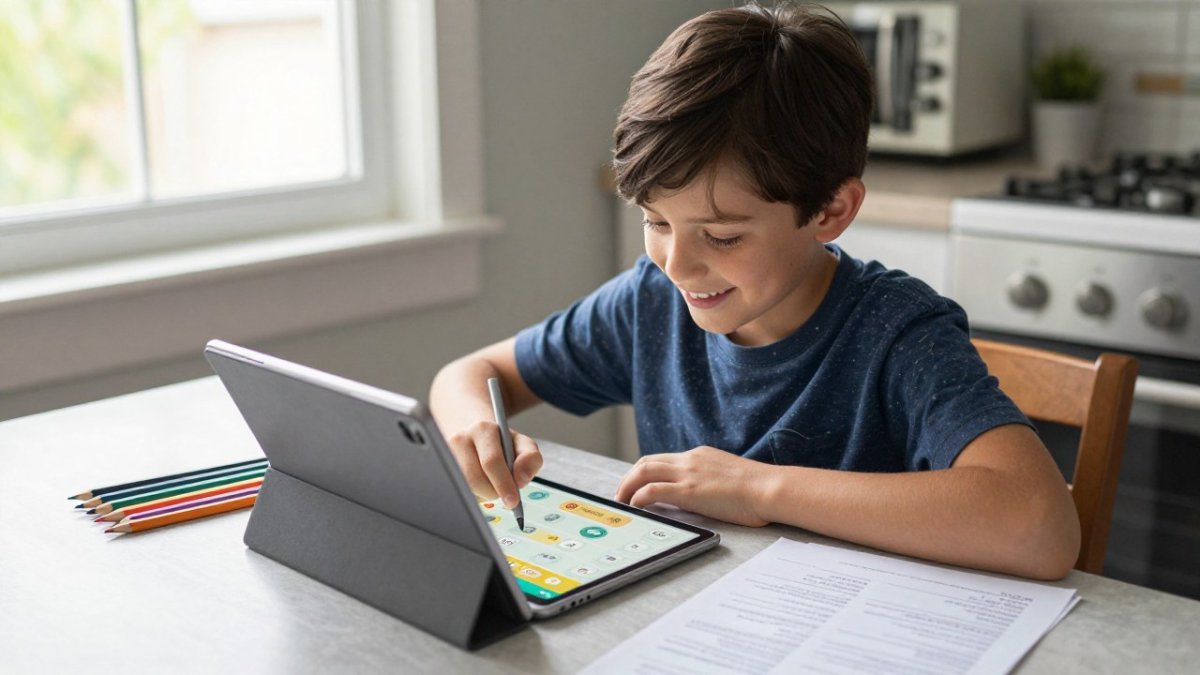
Story-driven quizzes. A child reads or listens to a narrative, then answers questions framed as part of the plot. The Molly Pitcher Life Story series from Capite Universe follows this format: Lesson 1AB's Quiz Quest 2 includes ten questions with an answer key.
Timed sorting challenges. Give a mixed pile of items and two categories. Speed adds engagement; the sorting requires retrieval.
Role-based problem solving. The child takes on a character and must recall facts to make a decision in the story.
For families who want the full library rather than single lessons, the Ultra Power All Access Pass membership opens every story, quiz, and printable in the Capite Universe collection.
Why Gamification Fails for Some Learners
Gamification can fail when the reward outweighs the content.
Several failure modes can occur. First, reward saturation: so many points, coins, and animations fire that the child stops tracking what the points were for. Second, mismatch: a competitive leaderboard demotivates the child who is already behind, which is the opposite of the intended effect. Third, and most common, the game rewards completion rather than accuracy, so a child can finish a level with a 40 percent correct rate and feel finished.
There is also a fatigue effect worth naming. Novelty drives a lot of early engagement, and novelty fades. A game that depends on surprise has a shelf life. A game built on a continuing story can give children a reason to come back that does not depend on novelty alone.
Watch out: if your child can finish a session without ever getting an answer wrong or being asked to try again, the design is not testing memory. It is testing clicking.
Choosing Story-Driven Lessons That Make Learning Stick
Story-driven lessons can help learning stick because narrative can supply structure and retrieval cues that isolated facts may lack. A fact attached to a character and a conflict has a hook. A fact in a list has nothing.
When you evaluate any story-based program, including ours, run this checklist:
- Does the story pause for retrieval, or does it only present?
- Are questions tied to the plot, or bolted on afterward?
- Does the program bring material back in later lessons?
- Is there a printable or offline component so practice can happen away from the screen?
- Can you see what your child got wrong, or only that they finished?
For a deeper look at how narrative structure supports retention, read our guide to story-based learning for elementary students.
The real test of any educational program is not whether your child enjoys the first session. It is whether they can still explain the material three weeks later. Capite Universe offers story-driven lessons for ages 6 to 14, interactive quizzes, printable PDF activities for offline practice, and new stories and lessons added regularly. Get started with Capite Universe and give your child a learning world worth remembering.
Frequently Asked Questions
Does gamified learning improve long-term memory retention?
The evidence is mixed. Some research has found gamification improves short-term knowledge retention without necessarily improving long-term retention, while other research has reported positive effects on long-term retention. The takeaway: gamified learning can support memory, but only when paired with techniques like spaced repetition and active recall that reinforce learning over time.
What is the difference between gamification and game-based learning?
Gamification adds game elements (points, badges, streaks, levels) to non-game activities, like earning stars for finishing a reading lesson. Game-based learning uses an actual game as the teaching tool, like a history quiz quest where answering correctly moves a story forward. Both can support memory, but game-based learning tends to embed content more deeply because the learning is the gameplay, not a reward layered on top.
What are the disadvantages of gamification in education?
Gamification can shift focus from understanding to earning rewards, and a 2019 study found short-term gains did not guarantee long-term retention. Effects can also vary by subject. Some children experience stress from competitive leaderboards or lose motivation when rewards stop. Extrinsic rewards can crowd out intrinsic motivation if used without balance. The fix is using game elements to reinforce recall and practice, not to replace genuine learning.
How can parents use educational games without increasing screen time?
Choose games that require active thinking rather than passive tapping, and set a clear session limit, such as 20 minutes. Pair screen-based games with offline recall: after a lesson, ask your child to explain what happened or complete a printable worksheet. Story-driven platforms that include printable activities let you shift learning off-screen. For ages 6 to 14, short, focused sessions with a follow-up conversation beat long passive stretches for retention.


