Signs Your Child Is Building Strong Problem-Solving Skills?

Last Updated: October 29, 2026
Quick Summary
Strong problem-solving skills show up when a child keeps trying after a mistake, tries a second approach, and asks useful questions like "What if I turn it?" Watch for these behaviors during everyday play, homework, and chores rather than on a formal test. Look for a pattern over several weeks, not a single success.
- Ages 6 to 8: your child rebuilds a fallen tower or tries a different piece.
- Ages 9 to 11: your child plans steps or sorts materials before starting a project.
- Ages 12 to 14: your teen compares options and explains why they chose one.
- Keep a short weekly note of one example to see growth over a month.
- Wait five to ten seconds before offering a hint so your child tries again.
Table of Contents
- What Problem-Solving Skills Look Like in Children Ages 6 to 14
- Observable Signs by Age: 6 to 8, 9 to 11, and 12 to 14
- Examples of Problem-Solving Skills in Children at Home, School, and With Friends
- A Quick Checklist of Everyday Problem-Solving Behaviors
- How to Build Problem-Solving Skills With Hands-On Activities
- How to Teach Problem-Solving Skills to Kids Without Taking Over
- Start Building These Skills With One Story-Driven Adventure Today
- Frequently Asked Questions
What Problem-Solving Skills Look Like in Children Ages 6 to 14
Problem-solving skills show up when a child faces a task without an obvious answer and works through it step by step.
You don't need a test to spot them. Watch what your child does when the first attempt fails.
Problem-solving sits close to related abilities like critical thinking, persistence, and creativity.
Children also develop at different speeds. A child who struggles with one type of puzzle may excel at another.
Observable Signs by Age: 6 to 8, 9 to 11, and 12 to 14
Skills change as children get older, so the signs change too. Use these as rough guides, not checklists to pass or fail. Watching for the behavior in ordinary moments, homework, chores, play, is often more revealing than a formal test. A single success is a data point; a pattern over weeks is a sign.
Ages 6 to 8: Trying Again After a Mistake
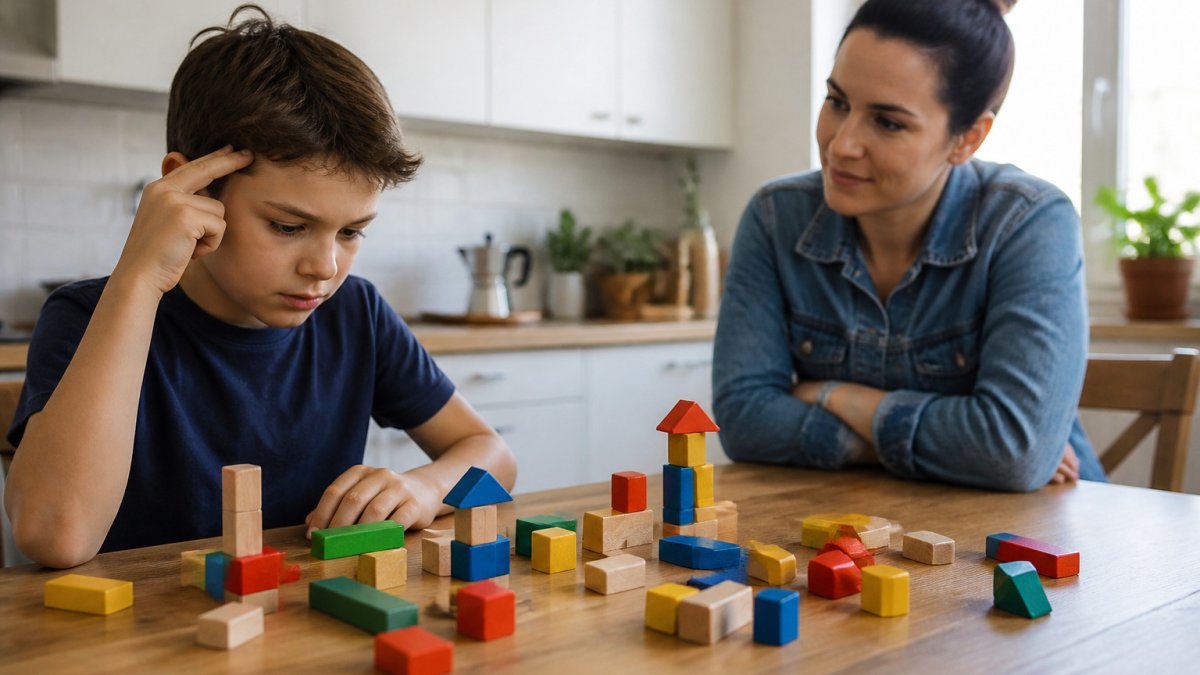
At this age, the biggest sign is a child who keeps trying after getting something wrong. A child might rebuild a tower that fell, count the pieces again, or ask, "What if I put the red one underneath?"
Look for these specific behaviors during everyday routines:
- Rebuilding after a collapse. After a block tower falls, your child starts again without being told, maybe with a wider base or fewer blocks on top.
- Asking a useful question. Instead of "I can't do it," your child asks, "Where does this piece go?" or "What if we turn it?"
- Trying a second strategy. If a puzzle piece doesn't fit, your child rotates it, tries a different piece, or looks at the picture on the box before asking you.
A common pattern at this age is that the child needs a prompt to try again. You can support the skill by asking, "What else could you try?" and waiting five to ten seconds before offering a hint.
Ages 9 to 11: Planning Before Acting
Children in this range start thinking ahead. They may sketch a plan before a science project, sort materials before building, or say, "First we need to figure out how much time we have."
Specific signs to watch for:
- Making a plan before starting. Your child writes a list, draws a rough sketch, or lays out materials before beginning a project.
- Breaking a task into steps. Your child says, "First I'll do the easy problems, then the hard ones," or divides a chore into parts.
- Explaining a choice. When asked why they picked one approach, your child gives a reason, even a rough one, such as "This way is faster" or "That one looked harder."
At this age, you can build the skill by asking your child to explain their plan before you offer help. A simple "Walk me through what you're going to do first" gives them practice in reasoning aloud.
Ages 12 to 14: Weighing Options and Explaining Choices
Older students begin comparing several solutions and justifying their pick. A teen might say, "I chose this method because it's faster, even though it's less accurate," or change a plan after seeing new information.
Specific signs to watch for:
- Comparing options aloud. Your teen lists pros and cons of two approaches before choosing.
- Justifying a decision. Your teen explains why they picked a particular solution, even if you disagree with the choice.
- Revising after new information. Your teen changes a plan when they learn something new, for example, reworking a schedule after a practice is moved.
At this age, you can support the skill by asking, "What are your options, and what's your reasoning?" and then letting your teen make the call when the stakes are low.
How to Observe Progress Without Formal Testing
You don't need a test to notice growth. Try these simple habits:
- Keep a short note. Once a week, jot down one example of your child trying a second approach, explaining a choice, or asking a useful question. Over a month, you'll see a pattern.
- Watch during play and chores. These low-pressure moments show problem-solving more clearly than a timed worksheet.
- Compare to last month, not to other children. Ask yourself, "Is my child trying more strategies than a month ago?" rather than "Is my child ahead or behind?"
If you want a ready-made activity to practice together, the Kids Personalized Story Book is one option.
Examples of Problem-Solving Skills in Children at Home, School, and With Friends
Problem-solving shows up in different places, and each setting tests different parts of the skill.
At school: A student finishes a math word problem by drawing a diagram first, or regroups with a lab partner after the first experiment doesn't work.
Seeing a skill in more than one setting is a useful sign that it is becoming part of how the child thinks.
A Quick Checklist of Everyday Problem-Solving Behaviors
Use this list over a few weeks, not in a single sitting. Check what you notice, and don't worry about items you haven't seen yet.
Kids Personalized Story BOOK App →
- Tries a second approach after the first one fails
- Asks "why" or "what if" questions about how things work
- Breaks a big task into smaller steps
- Explains the reasoning behind a choice
Most children show several of these at any given time. A child who checks only two or three items isn't necessarily behind. Notice which behaviors are growing.
Problem-Solving vs. Related Skills: What You're Actually Seeing
Problem-solving overlaps with several other abilities, and it helps to know the difference so you can notice the right thing.
- Executive function is the set of mental processes that let a child plan, focus, and switch gears. Problem-solving uses executive function, for example, when a child holds a plan in mind while trying a step. A child with strong executive function may still struggle with a specific problem if they lack background knowledge.
- Language matters because explaining a choice requires words. A child who can describe their reasoning is showing both language and problem-solving. A child who solves a puzzle silently may still be problem-solving; don't confuse quiet with stuck.
- Emotional regulation shows up when a child stays calm enough to try again after a failure. A child who melts down at the first mistake may have strong problem-solving ideas but need support with frustration. Praise the calm retry as much as the solution.
- Critical thinking is the habit of questioning whether an answer makes sense. A child who asks "Does this actually work?" is blending critical thinking with problem-solving.
A simple way to tell them apart: problem-solving is the act of working toward a solution; the related skills are the tools that make that act possible. When you see a behavior on the checklist, ask yourself which tool your child is using, and which one might need support.
When to Seek Guidance
Developmental variation is normal. Some children show these signs earlier or later than peers, and a child who struggles in one area may excel in another.
Consider talking with a teacher or a qualified professional if you notice:
- Your child consistently gives up at the first sign of difficulty and seems distressed, not just frustrated.
- Your child rarely tries a second approach across many settings over several months.
- Your child's difficulty with planning or reasoning interferes with daily routines or schoolwork.
This is not a diagnosis, and many children catch up with support. The goal is to notice patterns and ask for guidance when something feels persistently off.
For a low-pressure way to practice these behaviors together, you can explore Interactive Story Lessons for Middle School Success.
How to Build Problem-Solving Skills With Hands-On Activities
Hands-on play is one of the most effective ways to build these skills.
Step 1: Pick an open-ended activity. Building blocks, simple circuits, and sorting games work well.
Step 3: Let the first attempt fail. A failed tower teaches more than a perfect one handed over.
Step 4: Celebrate the process. Praise the strategy, such as "You tried a wider base.
For reading-based practice, a story-driven activity can work well. The Creative Writing Prompts for Kids: 50 Fun Story Starters offer a story-based starting point, and Interactive Story Lessons for Middle School Success is one option for older students.
| Step | What to do | Time or frequency |
|---|---|---|
| Pick an open-ended activity | Choose building blocks, simple circuits, or sorting games with several possible outcomes | Once to start |
| Ask one question, then wait | Try "How could you make it stand up?" and let the child respond | Before any hint |
| Let the first attempt fail | Ask what happened and what would change | After each failed try |
| Celebrate the process | Praise the strategy, not only the result | Every session |
How to Teach Problem-Solving Skills to Kids Without Taking Over
Many adults solve problems for children too quickly. That feels helpful in the moment but takes away practice.
Try these habits:
- Offer a hint, not the answer. "What have you tried so far?" keeps the thinking with the child.
- Allow productive struggle. A few minutes of frustration is normal and useful. Step in when the child is stuck for a long time and feeling discouraged, not at the first sign of difficulty.
- Ask the child to explain. Having a child describe their plan often reveals gaps they can fix on their own.
- Model your own thinking. Say aloud, "This didn't work, so I'll try a different way."
Mistakes are part of the process. A child who learns that errors lead to better ideas becomes more willing to try difficult tasks.
Start Building These Skills With One Story-Driven Adventure Today
Pick one activity from this article and try it with your child this week. Choose an open-ended task, ask one question, and wait before stepping in.
If you want a ready-made story to explore together, Kids Personalized Story Book is one option. For a younger reader who likes exploring, Dino Time Explorers Kids is another.
Frequently Asked Questions
What are signs that a child has strong problem-solving skills?
Look for a child who tries more than one approach when something does not work, who asks questions before giving up, and who can explain why they chose a particular strategy. Children with growing problem-solving skills also tend to break big tasks into smaller steps and keep going when a task is hard. These signs appear gradually, so look for a pattern across several weeks rather than a single good day.
At what age do children start solving problems independently?
Children begin solving simple problems on their own well before school age, often by trying a second way after the first fails. Between about ages 6 and 14, most children gain the ability to plan several steps ahead and to compare options. Independence grows at its own pace, so give your child room to try before stepping in.
What should I do when my child gets stuck on a problem?
Pause before offering the answer and ask one open question, such as "What have you tried so far?" Then suggest a smaller first step rather than solving the whole problem. Try this today: the next time your child gets stuck on homework or a puzzle, wait thirty seconds before speaking and see whether they find a new approach on their own.
What activities help children practice problem-solving?
Building blocks, puzzles, scavenger hunts, and board games all give children chances to test ideas and learn from mistakes. Story-driven learning, such as Capite Universe's Code In Time Full Lesson, places children inside an adventure built around logic and sequencing challenges. Choose activities where there is more than one correct route so your child has to make decisions.


