Printable Reading Adventures for School: 7 Fun Ideas

Table of Contents
- Why Printable Reading Adventures Work in the Classroom
- How to Set Up a Printable Reading Challenge for Students
- Reading Log Printable for Students: Tracking Progress Without the Busywork
- Reading Response Prompts for Students That Go Beyond Summaries
- Reading Activities for Reluctant Readers: Low-Pressure, High-Interest Options
- Adventure-Themed Printable Reading Adventures to Try This Year
- Conclusion: Building a Reading Habit That Lasts
- Frequently Asked Questions
Last Updated: October 13, 2026
Why Printable Reading Adventures Work in the Classroom
A printable reading adventure is a paper-based challenge that turns independent reading into a journey, with maps, trackers, and goals students can see and touch.
Teachers tell us the physical act of marking progress keeps kids coming back.
The American Library Association has long documented how summer learning loss sets readers back when structured reading stops ALA summer reading resources.
How to Set Up a Printable Reading Challenge for Students
Setting up a printable reading challenge for students takes about 20 minutes: pick a format, set a goal, print the tracker, and decide how you will celebrate. What most guides skip is what teachers actually need, matching the challenge to a grade band, running it inside a real class period, and handing out versions that work for every learner.
Choosing the Right Challenge Format
Three formats cover almost every classroom:
- Minutes-based: Students color one square for every 10 minutes read. Best for daily reading habits.
- Books-based: One badge per finished book. Best for fluent readers who finish quickly.
- Bingo or grid: Students complete a square per reading task. Best for variety and choice.
Match the format to your goal: minutes for daily reading time, a grid for breadth across genres.
Organizing Printables by Grade Band, Reading Level, and Age
A single tracker cannot serve a first grader and an eighth grader. Sort your printables along three filters before you print anything:
| Grade Band | Typical Reading Level | Challenge Format | Tracker Style |
|---|---|---|---|
| K-2 | Emerging, picture-supported | Minutes-based, 10-15 min/day | Large squares, draw-or-color response |
| 3-4 | Transitional chapter books | Books-based, 1 badge per book | Map with 8-12 stops |
| 5-6 | Fluent, multi-genre | Bingo or grid | Passport with stamps |
| 7-8 | Independent, longer texts | Minutes + genre grid | Journey map with written prompts |
Reading level matters more than grade label. A fourth grader reading at a second-grade level should get the K-2 tracker with the grade-appropriate prompt card, not a watered-down older sheet. Keep the tracker simple and raise the thinking.
Setting Achievable Reading Goals
A goal that is too high kills motivation in week one, and a class-wide number is a common mistake. Start with what a student already reads in a week, then add a small stretch: a reluctant reader at 15 minutes a night should aim for 20, not 60. Print the goal on the tracker so students see their target daily.
Running the Challenge in Class: Centers, Independent Reading, and Homework
The same printable can run in four classroom structures:
- Literacy centers: Print one adventure map per center. Students rotate through and add a stamp at each station. Works well for 15-20 minute blocks.
- Independent reading time: Students keep the tracker inside their book. They fill it in silently at the end of the block. No discussion required.
- Whole-class challenge: Post one large map on the wall. The class advances together as total minutes accumulate. Builds momentum but can pressure slower readers, pair it with a private individual tracker.
A common pattern: a whole-class map for motivation and a private tracker for accountability. The public one celebrates; the private one measures.
Differentiated and Accessible Versions
Every printable should have at least three variants ready to print:
- Low-ink: Black-and-white line art only. Saves toner and works on any copier.
- Large-print: 16-point or larger text, wider squares, fewer items per page.
- Dyslexia-friendly: Sans-serif font, off-white or cream background, increased line spacing, no justified text.
Printing one version for everyone is the fastest way to lose the students who need the challenge most.
Reading Log Printable for Students: Tracking Progress Without the Busywork
A reading log printable for students should take under 30 seconds to fill in; any longer and students stop using it.
Keep the fields minimal:
- Date
- Title
- Minutes read
That is it. Comprehension questions belong on a separate response sheet.
The difference between a log that works and one that gets abandoned is friction: a four-field log gets filled in, a twelve-field log gets lost.
Reading Response Prompts for Students That Go Beyond Summaries
Reading response prompts for students work best when they ask for thinking, not retelling. "Summarize chapter three" produces a summary. "Which character would you trust with a secret, and why?" produces reasoning.
Strong prompts push students past plot:
- Predict what happens next and explain your evidence
- Describe a choice a character made that you would have made differently
- Explain how the setting shaped the story
Matching Prompts to Grade Levels
Prompt complexity should climb with grade level, not just vocabulary.
| Grade Band | Prompt Focus | Example Prompt |
|---|---|---|
| Grades 1-2 | Feelings and pictures | Draw how the character felt and tell why |
| Grades 3-4 | Character and choice | What would you have done instead? |
| Grades 5-6 | Evidence and inference | What clues told you what would happen? |
| Grades 7-8 | Theme and author choice | Why did the author end the chapter here? |
The same story can serve every band. Only the prompt changes.
Reading Activities for Reluctant Readers: Low-Pressure, High-Interest Options
Reading activities for reluctant readers need to remove the audience. Many struggling readers avoid books because reading aloud feels like a test, and silent, private, choice-driven activities lower that barrier. Reluctant readers still need a reason to keep going past chapter one, a journey with a visible destination gives them one without adding pressure.
What Actually Works in Practice
- Let students choose any book, including graphic novels, manga, and short nonfiction
- Track minutes, not pages, so slower readers are not penalized
- Pair reading with a hands-on task like drawing a map of the story's world
Most reluctant readers can read; they just have not found a book worth the effort yet. Widen the menu, not the pressure.
Kids Personalized Story BOOK App →
Adventure-Themed Activities That Lower the Stakes
An adventure frame turns reading into movement without turning it into a performance. Each activity below is done alone, at a desk, with no audience:
- Map the journey: Students draw the route a character took and mark one decision point per chapter. No writing required beyond labels.
- Passport stamps: One stamp per finished chapter, colored in privately. The stamp is the reward, not the grade.
- Choose-your-path prompts: At the end of a chapter, the student writes two possible next moves and picks one. Builds inference without a quiz.
These work because the student is doing something with the story, not being tested on it.
Measuring Progress Without Pressure
Reluctant readers still need to show growth, but the measurement should be invisible to them. Track these quietly on your own copy:
- Reading stamina: Minutes read in one sitting, week over week
- Book completion rate: Books finished versus books started
- Genre range: Number of distinct genres or formats attempted
A student who starts at 8 minutes per sitting and reaches 15 by week six has made measurable progress even if the tracker only shows colored squares. Keep outcome data in your records, not on the student's sheet.
Matching Activities to Grade Bands
The same adventure frame scales across grade levels. Only the task changes:
| Grade Band | Activity Focus | Example Task |
|---|---|---|
| K-2 | Pictures and feelings | Draw the character's face at the end of the chapter |
| 3-4 | Choice and consequence | Write one sentence about what you would have done |
| 5-6 | Evidence and inference | List two clues that hinted at the ending |
| 7-8 | Theme and craft | Explain why the author ended the chapter where they did |
Pair each activity with a single learning objective, stamina, comprehension, fluency, or reading habit, so you can point to what the printable is actually building. An activity without an objective is just a worksheet.
Adventure-Themed Printable Reading Adventures to Try This Year
Adventure-themed printable reading adventures give students a reason to keep turning pages: a journey to finish, not just a book to complete. The theme supplies motivation a bare log cannot.
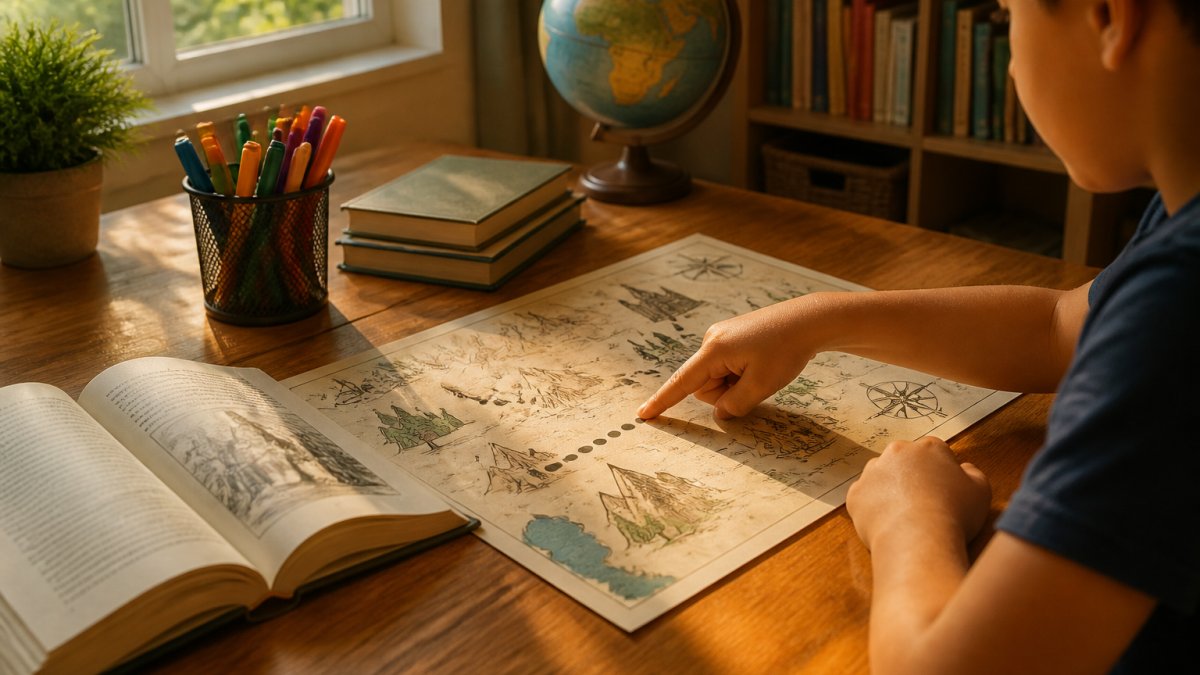
Here is how to build a printable reading challenge for students around a single theme:
- Map tracker: Each book moves the student one stop along a printed map
- Passport stamps: One stamp per finished chapter, colored as they go
- Story prompts: A response card per stop, tied to the theme
This is exactly how our In Time Adventures lessons work: each is a full lesson e-book with a story segment, a knowledge box, critical thinking questions, a hands-on activity, vocabulary words, and teacher or parent notes.

For example, Pirates in Time Full Lesson sends students across the Golden Age of Pirates with map activities, reading comprehension questions, and creative writing prompts. Wings in Time follows Bo through the history of flight, from early gliders to the Wright Brothers, for ages 5 to 10.

Both come as instant digital downloads, so you can print the activity pages the same day you plan the lesson.
Story-Driven Reading Journeys
A story-driven reading journey links every book a student reads to a larger narrative: instead of finishing a book and stopping, the student advances a plot.
The structure that holds up across grade levels:
- Pick a theme with a clear destination
- Break it into stops, one per book or per reading block
- Give each stop a short prompt or task
- Print a tracker that shows the whole route
- End with a printable reward
Teachers can run one journey for the whole class or let each student pick a theme. The class-wide version builds momentum; the individual version builds ownership.
Conclusion: Building a Reading Habit That Lasts
The hard part is not printing the tracker. It is week four, when the novelty has worn off and the sheet is still on the desk.
That is where a bigger story helps. At Capite Universe, our story-driven learning world keeps kids engaged through one continuous universe narrative, with printable activities and guided stories that fit into what you already teach.
Browse our full lesson library and pick a journey your students will want to finish.
Frequently Asked Questions
What should a classroom reading challenge include?
A strong classroom reading challenge includes clear goals (like minutes per day or books per month), a printable tracker students can color or fill in, age-appropriate book lists, and simple rewards. It should also have built-in flexibility for different reading levels. Research shows that students who set specific reading goals and track their progress are more likely to build a lasting reading habit. Include a mix of independent reading, guided reading activities, and comprehension checks to keep skills growing alongside motivation.
How can teachers make reading more engaging for reluctant readers?
For reluctant readers, choice and low-pressure formats matter most. Try reading activities like graphic novel book clubs, audio-supported reading, or adventure-themed challenges where students unlock story chapters as they read. Printable reading logs that let kids color in progress bars or add stickers work better than traditional logs for this group. Pair short reading assignments with hands-on response prompts, like drawing a scene or writing an alternate ending. The goal is to reduce the fear of failure and increase the fun factor.
How do you create a reading adventure for students?
Start with a theme (space, pirates, time travel) and map out a reading journey with checkpoints. Each checkpoint represents a book, a chapter, or a set number of reading minutes. Create or download printable reading adventures that include a map, a reading log, and response prompts tied to the theme. Add small challenges at each stop, like vocabulary hunts or comprehension worksheets. Capite Universe offers story-driven printable lessons that combine narrative immersion with skill-building, making it easy to launch a themed adventure in your classroom.
What printable activities help improve reading comprehension?
Effective printable activities for comprehension include story maps, character trait charts, cause-and-effect organizers, and guided reading question cards. Reading response prompts that ask students to predict, infer, or connect to personal experience also build comprehension. Pair these with a reading log printable so students track what they read and reflect on it. For a more immersive approach, adventure-themed printables that tie comprehension questions to a story plot help students stay engaged while practicing key skills.
How can students track their reading progress?
Students can track progress with a simple reading log printable that records date, title, minutes read, and a short reflection. For younger kids, color-as-you-go challenge sheets work well because they provide a visual sense of accomplishment. Older students might prefer a reading goals chart that tracks books across genres or a digital log. The key is consistency: a quick daily entry takes less than a minute and gives students a clear picture of their reading habit over time. Teachers can spot patterns and adjust goals as needed.


