How to Teach History to Multiple Grade Levels at Once

Quick Summary
To teach history to several grade levels at once, pick one shared historical topic for the whole family, then read the core text aloud together. After reading, ask one question per child and give each child a task matched to their ability. Keep the same topic running through the week so every age stays connected to one story.
- Pick one shared topic with clear characters, a clear sequence and enough depth for your oldest child.
- Read the core text aloud to the whole group, even when children read at different levels.
- Ask one question for the youngest, one for the middle child and one for the oldest about the same passage.
- Adjust expected answer length: one sentence for ages 6-8, three sentences for ages 9-11, a short paragraph for ages 12-14.
- Keep the shared history block to two or three sessions per week and protect the read-aloud day.
Table of Contents
- Why Teaching History to Multiple Grade Levels Works Well
- Step 1: Pick One Shared Historical Topic for the Whole Family
- Step 2: Plan a Shared Read-Aloud and Group Discussion
- Step 3: Differentiate Assignments by Age and Reading Level
- Homeschool History Activities That Work Across Ages
- Building a Homeschool History Schedule That Fits Your Week
- Choosing Homeschool History Lesson Plans and Your Next Step
- Frequently Asked Questions
Last Updated: October 31, 2026
Teach history to several children at once and it can sound like a juggling act, but it can make your week simpler. One shared story can serve a seven-year-old, a ten-year-old and a thirteen-year-old at the same time, as long as you adjust the work each child does with it. A single topic, taught in one sitting, can save prep time and give the family something to talk about at dinner. Legends In Time Historical Legends Full Lessons offers complete legend-based lessons whose activities can be pitched at different ages. This guide walks you through a practical method you can start this week. For a fuller look at structuring one curriculum across several ages, see our Homeschool Curriculum for Multiple Ages: A Parent's Guide. If you want the lesson material ready to go, Homes In Time Full Lesson from Capite Universe is a complete teacher-friendly option you can use as your shared topic.

Why Teaching History to Multiple Grade Levels Works Well
History lends itself to mixed-age teaching better than most subjects. A single story, event or era can be told once and then explored at different depths. Younger children take away the characters and the main events, while older children are ready for causes, consequences and sources. A shared approach like this can build family conversation instead of separating kids into their own silos.
It also gives you more time back. Instead of planning three separate history lessons, you plan one. The big ideas stay the same, and only the reading level and the assignment change. For more strategies on running several grade levels together, read our Homeschool Curriculum for Multiple Grade Levels: 7 Strategies.
Here is what most families gain:
- One prep session instead of several
- Shared vocabulary that every child hears and uses
- Natural discussion where older kids explain ideas to younger ones
- Consistent timelines that all children build together
Step 1: Pick One Shared Historical Topic for the Whole Family
Start by choosing a single topic that every child can enter, such as ancient Egypt, the American Revolution or the building of early American railroads. Pick something with clear characters, a clear sequence of events and enough depth for an older child to dig into. A focused topic keeps the week from sprawling into too many ideas.
Look at your children's grade levels and choose a topic that sits comfortably in the middle. A topic that is too advanced loses the youngest child, and one that is too simple bores the oldest. A lesson built around a story works well because it gives every child something to follow.
Once you have a topic, write down three to five big questions you want answered by the end of the unit. For example: What changed? Who made the decisions? What did ordinary people experience? These questions become the backbone of the lesson.
Quick checklist for picking a topic:
- Clear characters or people to follow
- A beginning, middle and end
- Enough depth for your oldest child
- Simple enough for your youngest to follow
Step 2: Plan a Shared Read-Aloud and Group Discussion
Read the core text aloud to the whole group, even when the children read at different levels. Reading aloud keeps the story moving and makes sure no child is stuck on hard words. Many families read a short passage each day and pause for a few questions before moving on.
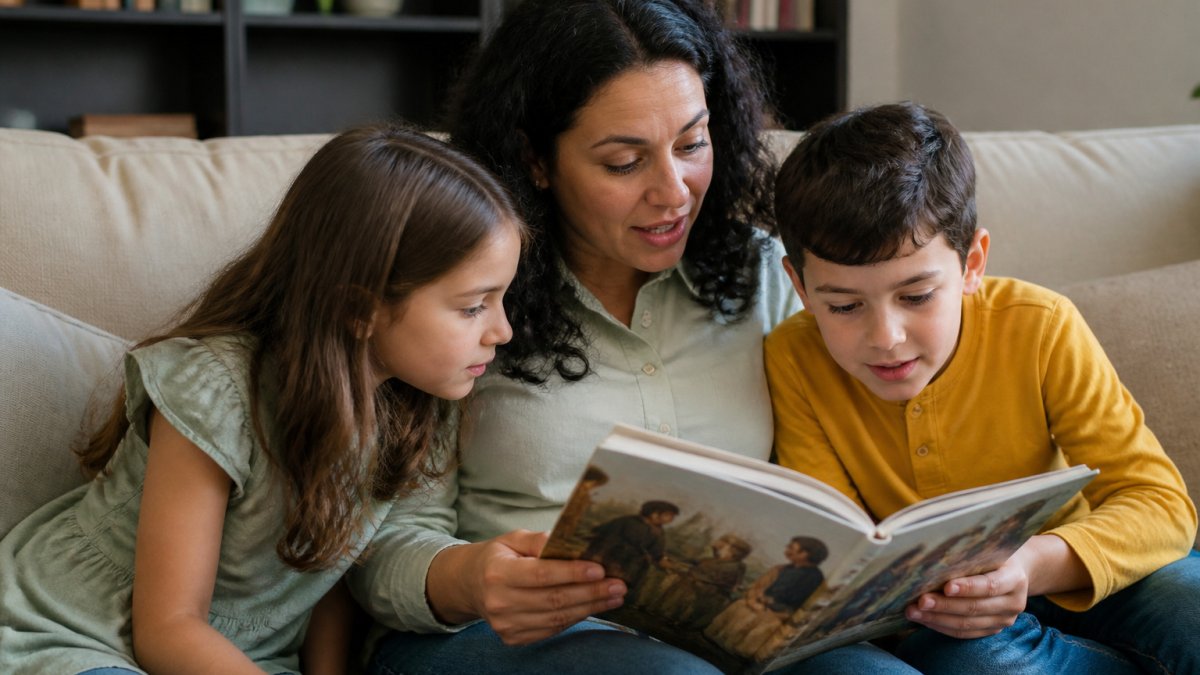
After reading, lead a short discussion. Ask one question for the youngest, one for the middle child and one for the oldest, all about the same passage. This approach lets each child contribute without feeling left behind. Keep discussions to 10 to 15 minutes so the momentum stays up.
Plan your read-aloud around a simple rhythm:
- Read a section aloud, about 10 minutes
- Pause to ask one question per child
- Discuss one big idea together
- Note a single new fact each child can remember
Step 3: Differentiate Assignments by Age and Reading Level
Once the shared story is done, give each child a task that matches their ability. The goal is not to make the work easier or harder for its own sake, but to ask each child to think at the right level. A seven-year-old might draw the main event and label it, while a thirteen-year-old might write a paragraph explaining why it mattered.
Here is a concrete way to set up history assignments by age and skill level, using the same topic (for example, the American Revolution):
Kids Personalized Story BOOK App →
- Younger children (ages 6-8): Draw a scene from the Boston Tea Party and label three people or objects. Orally narrate three events in order. Match pictures of colonial and modern objects.
- Middle children (ages 9-11): Write a five-sentence summary of one cause of the Revolution. Build a timeline with five dates. Explain in one paragraph why colonists were angry.
- Older children (ages 12-14): Compare two short primary source excerpts (for example, a patriot pamphlet and a loyalist letter). Write a one-page argument about whether the Revolution was justified. Research one figure and present a short oral report.
For children who read below grade level, keep the content at the shared level but adjust the reading load: provide an audio version of the read-aloud, use a graphic organizer for the written response, or allow oral answers instead of written ones. For children who need more challenge, add a research component, such as finding one additional source and evaluating its reliability, rather than simply assigning more of the same work.
Assessment in a mixed-age history lesson should also be age-adjusted. Use a simple rubric with three criteria: historical accuracy, use of evidence, and clarity of communication. For younger children, assess oral narration and labeled drawings. For middle children, assess short written summaries and timelines. For older children, assess source comparison and written arguments.
Homeschool History Activities That Work Across Ages
Activities are where mixed-age history teaching really pays off. A single activity can stretch to fit every child when you adjust the expectations.
Try these activities, each of which scales up or down easily:
- Shared timeline: Everyone adds events to one long paper strip, with older kids writing the dates and younger kids drawing the pictures
- Map work: Mark where the events took place, with younger children coloring and older children labeling places and routes
- Character role-play: Each child takes a different person from the story and answers questions in character
- Primary source reading: Younger children look at pictures from a document, while older children read a short excerpt
- Narration: Children retell the story in their own words, with the length and detail matched to their age
Building a Homeschool History Schedule That Fits Your Week
A consistent schedule keeps history from getting pushed aside by other subjects. Two or three shorter sessions per week rather than one long block can help young children stay focused. Pick days and times that fit your household and stick to them for the length of the unit. The schedule below is built specifically for a shared history topic, with the same content running through the week and the task load adjusted by age.
A sample week on the American Revolution might look like this:
| Day | Shared Activity (all ages) | Younger (ages 6-8) | Middle (ages 9-11) | Older (ages 12-14) | Time |
|---|---|---|---|---|---|
| Monday | Read-aloud: the Boston Tea Party | Draw and label one scene | Write three facts learned | List two causes and one effect | 30 min |
| Wednesday | Map work: colonies and trade routes | Color the map | Label three colonies and one route | Explain one trade conflict in a paragraph | 40 min |
| Friday | Discussion and narration | Orally retell two events | Write a five-sentence summary | Compare two sources and write a short response | 35 min |
Adjust the table to fit your family. The key is to keep the same shared topic running through the whole week so each session builds on the last. If one child needs more time, give them a longer independent task rather than dropping the group activity.
Managing chronological scope gaps. One of the most common challenges in mixed-age history is that children may be at different points in a history sequence. First, run a shared topic that sits in the middle of the sequence and use it as a bridge, for example, a unit on exploration can connect ancient trade routes to the modern world. Second, let older children pursue an independent history strand alongside the shared unit, with one session per week set aside for their own reading and research.
If a child joins the shared study mid-cycle, give them a one-page summary of the story so far and a short list of key people and events. Pair them with an older sibling for the first discussion so they can catch up quickly. A common pattern is to spend the first session on a timeline review, where every child adds what they already know before the new topic begins.
For a teacher-focused lesson you can work from, Homes In Time Full Lesson is a complete option built around a shared story.
Choosing Homeschool History Lesson Plans and Your Next Step
By now you have a method: pick one topic, read together, differentiate the work and keep a steady schedule. The easiest next step is to choose a lesson plan that already follows this structure, so you spend less time building materials from scratch. Look for a plan that includes a read-aloud text, age-adjusted questions and a few flexible activities.
Browse the wider Capite Universe library to find a topic that matches your family's current unit.
Start this week with one small step. Choose your topic, plan the first read-aloud and write three questions to ask after reading. Shop with us at Capite Universe to find the lesson that fits your children's ages and get your first history session on the calendar.
Frequently Asked Questions
How do you homeschool multiple grade levels at the same time?
Teach one shared history topic to everyone together, then give each child work matched to their age and reading level. Start with a read-aloud and group discussion so all children hear the same content. Younger children can narrate orally or draw a picture, while older children write a short response or complete a timeline entry. Keep the shared portion to 20 to 30 minutes so younger children stay focused, and let older students work independently afterward. This approach keeps one lesson plan for the whole family while still meeting each child where they are.
Can children of different ages learn history together?
Yes. Children of different ages can learn the same historical topic together because the core story, people and events stay the same. The difference is in depth and output. A six-year-old might name the main character and place the event on a simple timeline, while a 13-year-old might compare two primary sources and explain cause and effect. Grouping children by shared content rather than by grade makes history one of the easiest subjects to combine across ages.
How do you keep younger children engaged during history lessons?
Use short, active segments. Read aloud with pauses for questions, let younger children point to places on a map, and give them a hands-on task such as placing picture cards on a timeline. Limit passive listening to about 10 to 15 minutes before switching to movement or a simple activity. Stories with characters and a clear sequence hold attention longer than lists of dates, so choose narrative-driven materials when you can.


