Fun Reading Activities for 10 Year Olds: 2026 Guide

Table of Contents
- Why 10 Is the Sweet Spot for Reading Engagement
- 1. Reading Games That Turn Pages Into Play
- 2. How to Improve Reading Comprehension Skills With Story-Based Activities
- 3. Reading Comprehension Strategies for 10 Year Olds That Stick
- 4. Book Clubs and Peer-to-Peer Reading Engagement
- 5. Building Vocabulary and Comprehension Through Creative Writing
- 6. Audiobooks, Digital Reading, and Tech-Balanced Screen Time
- 7. Neurodivergent-Friendly Reading Activities and SEL Through Stories
- Frequently Asked Questions
Last Updated: September 15, 2026
Why 10 Is the Sweet Spot for Reading Engagement
Ten is the age where reading stops being a skill you're taught and starts becoming a habit you choose. Kids at this stage can decode almost anything, but whether they reach for a book or a screen comes down to one thing: whether reading feels like fun or homework. This guide from Capite Universe covers fun reading activities for 10 year olds that build real literacy skills without the fight.
The stakes are higher than most parents realize. According to the National Center for Education Statistics, reading scores for fourth graders have declined in recent years, and the gap between kids who read for pleasure and kids who don't keeps widening. Ten-year-olds sit right at the pivot point: still young enough to play, old enough to think critically about what they read.
Below, we'll show you seven activity categories you can start tonight, from games to book clubs to creative writing.
1. Reading Games That Turn Pages Into Play
The fastest way to get a 10-year-old reading is to stop calling it reading. Reading games work because they add a goal, a timer, or a competitor to something kids already do passively.
Three Games You Can Set Up Tonight
- Chapter Treasure Hunt. Write five comprehension questions on sticky notes and hide them around the house. Your child reads one chapter, then hunts for the next question. Each correct answer earns a clue to a small prize.
- Sight Word Speed Round. Time your child reading a list of sight words or vocabulary from their current book. They race their own record, not a sibling's. Beat yesterday's time and they pick the next bedtime story.
- Character Guess Who. One player describes a character from a book using only traits and actions. The other guesses who it is. This builds text analysis and vocabulary without feeling like a quiz.
2. How to Improve Reading Comprehension Skills With Story-Based Activities
Reading comprehension is the ability to understand, interpret, and connect with what a text says, not just to read the words aloud correctly. For 10-year-olds, comprehension grows fastest when stories give them something to react to.
The Read-Aloud Pause Technique
Read one page aloud together, then stop and ask a single open question: "What do you think happens next, and why?" This forces prediction, which is one of the strongest comprehension strategies for 10 year olds (WWC). Wait a full ten seconds for an answer. Most parents jump in too fast.
Story-driven formats make this easier because the narrative itself creates the pause points. Capite Universe builds its lessons around ongoing adventures, so kids naturally want to find out what happens next, which is exactly the curiosity that drives comprehension.

3. Reading Comprehension Strategies for 10 Year Olds That Stick
Four strategies carry most of the weight at this age: predicting, questioning, visualizing, and summarizing. Teach them one at a time, not all at once.
- Predicting: "What will the character do now?"
- Questioning: "Why did the author include this detail?"
- Visualizing: "Draw the scene in your head, then sketch it."
- Summarizing: "Tell me the chapter in three sentences."
A common mistake is drilling these as worksheets. In practice, they work best as quick conversations during reading, two or three minutes at most.
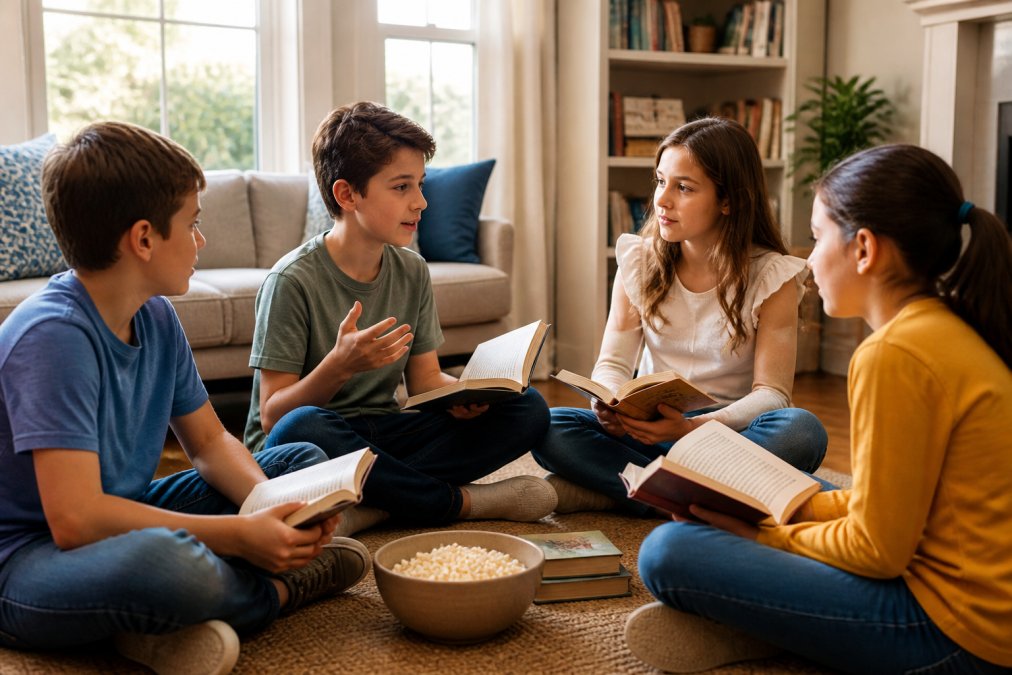
4. Book Clubs and Peer-to-Peer Reading Engagement
Peer discussion is the single most underused reading strategy for this age group. Kids care far more about what their friends think than what a parent recommends, and a book club turns reading into a social event.
Start with three or four kids, one book, and a fixed weekly time. Keep the first meeting short: snacks, one discussion question, done. Rotate who picks the next book so every child feels ownership.
5. Building Vocabulary and Comprehension Through Creative Writing
Vocabulary building sticks better when kids use new words than when they memorize them. Creative writing forces that use.
Try a "story swap": your child writes the first paragraph of a story, you write the second, and back and forth until it ends. Each round, introduce one new vocabulary word and require the other person to use it. This builds narrative skills, critical thinking, and word retention at the same time.
For reluctant writers, start with a prompt tied to a book they already love. Rewriting a favorite scene from a different character's point of view removes the blank-page problem.
6. Audiobooks, Digital Reading, and Tech-Balanced Screen Time
Audiobooks count as reading (pubmed.ncbi.nlm.nih.gov). They build fluency, vocabulary, and narrative skills, and for struggling or reluctant readers they remove the decoding barrier that makes books feel like work. Many libraries offer free audiobook access through their apps, which is worth checking before you pay for anything.
The balance question matters more than the format question. A useful rule: if the screen is doing the reading to your child, it's passive. If your child is choosing, pausing, re-reading, or discussing, it's active. Capite Universe's digital lessons are built around that second category, with printable activities that pull kids off the screen to write, draw, and respond.
| Format | Best For | Watch Out For |
|---|---|---|
| Physical books | Independent reading, bedtime | Harder for struggling readers |
| Audiobooks | Fluency, reluctant readers | Can become passive if unchallenged |
| Digital story apps | Engagement, interactivity | Screen time adds up fast |
| Printable activities | Off-screen skill practice | Needs parent setup time |
7. Neurodivergent-Friendly Reading Activities and SEL Through Stories
For neurodivergent kids, the standard advice often backfires. Dense paragraphs, long sittings, and open-ended questions can overwhelm rather than engage. Shorter sessions, clear structure, and predictable formats work better.
Try these adjustments:
- Break reading into 10-minute blocks with a visible timer
- Let the child choose the format: audio, print, or digital
- Use graphic novels and illustrated texts without apology
- Ask concrete questions ("What did she do?") before abstract ones ("How did she feel?")
Stories also carry social-emotional learning. When a character faces fear, loss, or friendship trouble, kids practice naming emotions safely through someone else's experience. That's literacy and emotional development in the same activity.
Reading motivation at 10 rarely comes from pressure. It comes from finding the right story at the right moment, and from adults who make reading feel like something worth choosing. Capite Universe was built for exactly this: a story-driven learning world where kids ages 6 to 14 explore galaxies and ancient kingdoms while building reading, critical thinking, and creativity. Every lesson is teacher approved, delivered instantly as a digital download, and structured so parents and teachers can use it without prep work. Get started with Capite Universe and give your 10-year-old a reason to turn the page.
Frequently Asked Questions
What are some fun reading games for 10-year-olds?
Try a story dice game where each roll adds a new plot twist your child has to write or narrate. Chapter charades works well too: kids act out a scene from their current book while the family guesses. You can also run a reading scavenger hunt, hiding questions about characters and settings around the house for your child to find and answer. These formats mix movement, competition, and storytelling, which keeps reading activities feeling like play instead of homework.
How do I get my 10-year-old to enjoy reading if they resist it?
Start with what they already love. A child obsessed with trains will read a train-centered story far more willingly than a random novel. Let them choose graphic novels, magazines, or short chapter books without judgment, and read alongside them rather than quizzing them afterward. Fifteen minutes of low-pressure reading beats an hour of forced reading. Story-driven digital content can help here because the narrative pulls kids forward before they notice they are practicing comprehension.
How can I improve my 10-year-old's reading comprehension skills at home?
Use the pause-and-predict method. Every few pages, stop and ask what your child thinks happens next and why. This builds inference and critical thinking, two core comprehension skills. After a chapter, ask them to retell it in three sentences, then connect it to something in their own life. Keep sessions short, around 15 to 20 minutes, and rotate between fiction, nonfiction, and audiobooks so comprehension practice does not feel repetitive.
Are audiobooks and digital reading tools good for 10-year-olds?
Yes, when they are used alongside print, not instead of it. Audiobooks build fluency, vocabulary, and listening comprehension, which supports reading comprehension strategies for 10 year olds who struggle with decoding. The key is balance: pair a short audiobook session with a print chapter so your child connects sounds to text. Story-based digital platforms that combine narration, visuals, and interactive questions tend to hold attention longer than passive video.
What reading activities work well for neurodivergent 10-year-olds?
Multisensory formats tend to work best. Let your child build scenes with blocks while listening to a story, trace sight words in sand or shaving cream, or act out dialogue with puppets. Break reading into short five-to-ten-minute blocks with movement breaks in between, and allow graphic novels, audiobooks, or read-alouds as valid reading. The goal is engagement and comprehension, not a specific format, so follow what keeps your child curious rather than what looks like traditional reading.


