Engaging Reading Activities for 2026: 7 Ideas That Work

Table of Contents
- Why Engaging Reading Activities Matter More in 2026
- Before, During, and After Reading Activities That Build Comprehension
- Reading Comprehension Activities for Kids That Go Beyond Worksheets
- Reading Games for Elementary Students: Low-Prep and Ready to Use
- Reading Activities for Reluctant Readers: Start With Story, Not Skill Drills
- How to Track Progress and Keep Engagement Going All Year
- Conclusion: Pick Two Activities and Start This Week
- Frequently Asked Questions
Last Updated: October 12, 2026
Why Engaging Reading Activities Matter More in 2026
Reading scores have plateaued while screen time climbs, and that gap is exactly where engaging reading activities for in 2026 earn their keep. At Capite Universe, we build story-driven lessons for kids ages 6-14, and we hear the same thing from teachers and parents: worksheets alone do not hold attention anymore. The fix is not more drills. It is better-designed activities.
This guide covers seven activity types, each with materials, prep time, and a way to check that learning actually happened.
Before, During, and After Reading Activities That Build Comprehension
Before, during, and after reading activities split a lesson into three phases: set a purpose, monitor thinking, and reflect. This structure works because comprehension builds in layers, not in one pass.
Before Reading: Set the Purpose in Five Minutes
Skip the long preview. Ask one question the text will answer, then have students predict. Prep time: under five minutes. Materials: sticky notes. Reading Rockets comprehension strategies outlines how purpose-setting primes readers before they start.
During Reading: Keep Students Thinking, Not Just Decoding
Pause at two or three points. Students jot one question or one connection per pause. A common mistake is pausing too often, which breaks the story's pull.
After Reading: Turn the Story Into a Conversation
Ask students to retell, argue, or rewrite. Discussion beats a quiz because it forces students to build meaning out loud.
| Phase | Activity | Prep Time | Skill Built |
|---|---|---|---|
| Before | Purpose question and prediction | 5 min | Inference |
| During | Stop-and-jot notes | 0 min | Monitoring |
| After | Retell or debate | 10 min | Summarizing |
Reading Comprehension Activities for Kids That Go Beyond Worksheets
Reading comprehension activities for kids work best when students produce something: a drawing, a map, a short scene. We group them into three types.
- Visual mapping: Students sketch the story's setting or character web.
- Role-play: Pairs act out a scene, then explain a character's choice.
- Written response: A three-sentence letter to a character.
Each type takes 15-25 minutes and needs only paper and pencils. For independent reading, our Kids Personalized Story Book App ($7.99) lets a child become the hero of a printable story, which gives mapping and retelling activities a text they already care about.

Reading Games for Elementary Students: Low-Prep and Ready to Use
Reading games for elementary students need three things: clear rules, five minutes of setup, and a named skill target. Most practitioners find that games fail not because the idea is bad but because the skill link is invisible, so each game below lists the grade band, materials, prep time, skill built, and one accessibility adaptation.
| Game | Grade Band | Materials | Prep Time | Skill Built | Accessibility Adaptation |
|---|---|---|---|---|---|
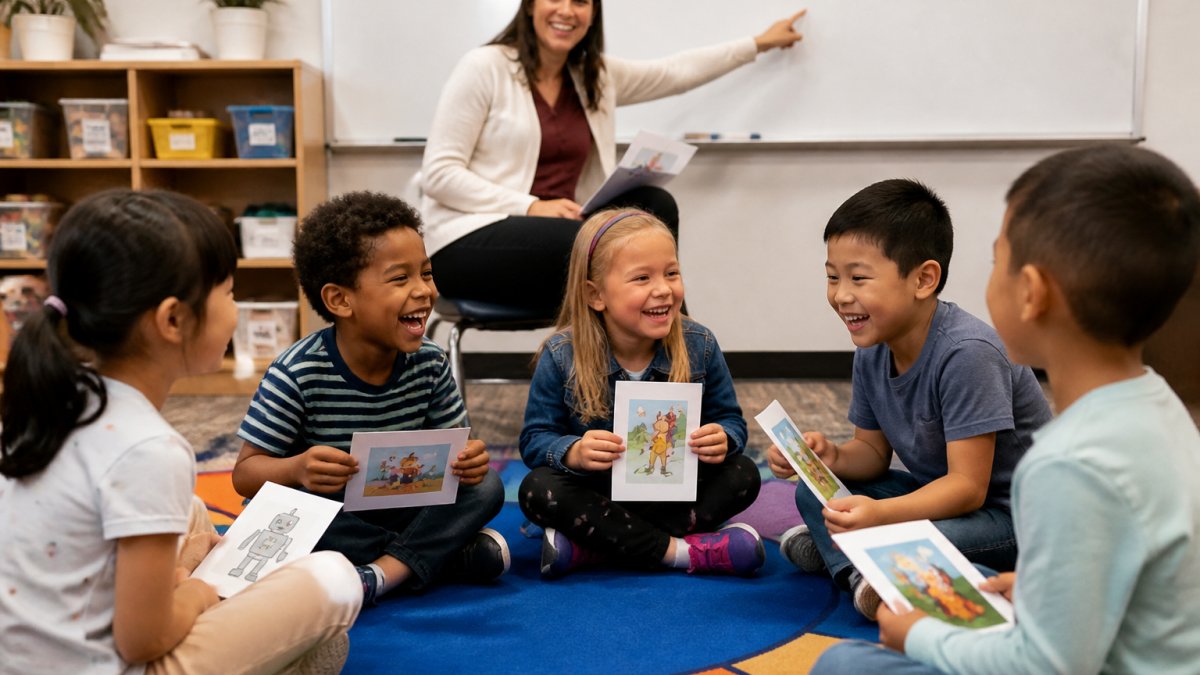
| Story Card Shuffle | K-2 | 5 printed scene cards per team | 5 min | Sequencing | Add picture-only cards for pre-readers or multilingual learners |
| Word Hunt Relay | 2-4 | Vocabulary cards, tape | 5 min | Vocabulary in context | Place cards at desk height for students with mobility needs |
| Two Truths and a Fib | 3-5 | Chapter text, index cards | 3 min | Inference and evidence | Allow oral responses or a speech-to-text tool |
| Character Hot Seat | 3-5 | Character list, timer | 2 min | Perspective-taking | Provide sentence starters and a partner option |
| Echo Reading Pairs | 1-3 | Two copies of a short passage | 2 min | Fluency | Pair a stronger reader with a developing reader; allow whisper volume |
How to run each one
- Story Card Shuffle. Print five scenes on cards. Teams race to order them, then justify the order with one sentence per card. The justification is the comprehension check, not the race.
- Word Hunt Relay. Hide vocabulary cards around the room. Students match each card to the sentence where it belongs. Keep the sentences on a single sheet so the task stays about meaning, not memory.
- Two Truths and a Fib. Students write three statements about a chapter; classmates spot the false one and cite the page that proves it. This is the fastest way to see whether students can point to evidence.
- Character Hot Seat. One student answers questions as a character. Rotate every 60 seconds so every student takes a turn.
- Echo Reading Pairs. One partner reads a sentence; the other echoes it. Swap after each paragraph. This builds fluency without the pressure of a public read-aloud.
Low-tech and digital versions
Every game above works with paper and pencil. If your classroom has devices, the same games run in a shared document or a slide deck: Story Card Shuffle becomes a drag-and-drop slide, Word Hunt Relay becomes a matching quiz, and Character Hot Seat becomes a recorded video response. Choose the version that matches your device ratio, not the version that looks newest.
Reading Activities for Reluctant Readers: Start With Story, Not Skill Drills
Reading activities for reluctant readers should start with choice, not correction. A struggling reader who picks the book reads more, and volume drives growth. National Literacy Trust research on reading for pleasure has documented the link between voluntary reading and reading attainment.
Three moves that work:
- Let the student choose from three options, never one assigned text.
- Start with a story at their interest level, even if the reading level is lower.
- Track minutes read, not pages finished.
Our Barkus Kids Edition Book 1 ($7.99) uses simple language and gentle pacing for early readers, and The Pendant of Many Realms Kids Edition Book 2 ($5.99) adds teamwork themes for ages 4-7. Both give reluctant readers a full story they can finish, which matters more than difficulty.


How to Track Progress and Keep Engagement Going All Year
Most activity lists stop at the idea. This section covers the part competitors skip: how to tell whether an activity actually worked, and how to keep it working from August through May.
Track two things, not one
Reading progress and reading engagement are different measurements. A student can finish a book and still disengage. Track both:
Kids Personalized Story BOOK App →
- Progress: minutes read, titles finished, and a two-question exit ticket every two weeks.
- Engagement: a one-to-five self-rating after each activity, plus a simple tally of who volunteers to share.
A reading log works only if students fill it in during class, not at home. Keep it to three columns: date, title, minutes. Add a reading board where students post a sticky note for each finished book, and the board becomes the motivation.
Assess without grading the log
Use three lightweight checks instead of a quiz:
- Two-question exit ticket. One literal question and one inference question. If students cannot answer both, the activity needs adjusting, not the student.
- One-sentence summary. Ask students to summarize the day's reading in one sentence. This surfaces comprehension gaps faster than a worksheet.
- Oral retell. A 60-second retell to a partner. Record it on a device if you want a running portfolio.
Differentiate by reading ability
The same activity can serve three readers if you change the support, not the task:
- Developing readers: provide sentence starters, a word bank, and a partner.
- On-level readers: provide the task as written.
- Advanced readers: ask for evidence, counterarguments, or a second text on the same topic.
Accessibility and inclusive adaptations
For multilingual learners, allow first-language planning before English output. For students with dyslexia, offer audiobook versions, larger print, and extra time. For students with attention needs, chunk the activity into five-minute segments with a visible timer. These are not modifications to the skill, they are modifications to the path.
A year-round rotation that holds up
Rotate activity types monthly: games in month one, role-play in month two, mapping in month three, then repeat with harder texts. Check comprehension every two weeks with the exit ticket. Revisit the engagement self-ratings at the end of each month; if a category drops below a three, swap it out rather than pushing through.
Summer and seasonal extensions
Summer reading programs and seasonal challenges work best when they reuse the same tracking sheet students already know. A summer challenge that introduces a new log every June loses the habit you built all year. Keep the format, change the theme.
Conclusion: Pick Two Activities and Start This Week
The hardest part of engagement is starting small enough to sustain. Choose two activities from this guide, run them for two weeks, and adjust based on your exit tickets. For a ready-made option, Pirates in Time Full Lesson ($7.99) pairs a full story with comprehension questions, vocabulary, and hands-on activities for ages 6-12, and Homes In Time Full Lesson ($7.99) does the same for social studies. Get started with Capite Universe and give your readers a story worth finishing.
Frequently Asked Questions
What are some engaging reading activities for kids?
Start with activities that connect reading to something active. Try a story-themed scavenger hunt where kids find objects mentioned in the text, or a character interview where one child plays a book character and answers questions in that voice. For a digital option, the Kids Personalized Story Book App ($7.99) turns a child's name, favorite animal, and interests into a full personalized story they can read and print. The key is pairing the text with a task, not just asking kids to sit and read silently.
How can I make reading more engaging for reluctant readers?
Lead with story and interest, not skill drills. Let the child pick the topic, then build the activity around it. Short, high-interest digital storybooks work well because they finish fast and feel like a win. Barkus Kids Edition Book 1 ($7.99) uses simple language and gentle pacing for early readers, and Bubble Dome Crew Kids Edition Book 1 ($5.99) adds an underwater adventure angle for kids who respond to action and teamwork themes. Ten focused minutes beats thirty forced minutes.
What activities help improve reading comprehension?
Comprehension grows when kids do something with what they read. After a chapter, ask them to retell it in three sentences, draw the setting, or predict what happens next. Before reading, preview vocabulary and set a purpose. During reading, pause to ask what a character is feeling. Capite Universe lesson products like Pirates in Time Full Lesson ($7.99) include built-in comprehension questions, vocabulary words, and critical thinking prompts, so the comprehension work is already structured into the story.
What can students do before, during, and after reading?
Before reading, students preview the cover, make predictions, and learn two or three key vocabulary words. During reading, they pause at set points to summarize, ask questions, or note a surprising detail. After reading, they discuss, write, or create something tied to the story. Homes In Time Full Lesson ($7.99) follows this structure with comprehension checks and reflection prompts built into each chapter, which makes the routine easy to repeat across grade levels.
How do you make a book discussion fun for kids?
Give the discussion a format. Try a mock interview where one child is the main character, a two-minute debate about whether the character made the right choice, or a vote on the best scene with reasons. Keeping it to five or six minutes works better than a long open discussion. For reluctant talkers, start with a concrete question like 'What would you have done in that cave?' rather than 'What did you think of the book?'


