Best Story Universe to Improve Reading Fluency

Table of Contents
- Why Story Continuity Beats Standalone Books for Reading Fluency
- How We Evaluated These Narrative Reading Programs for Kids
- Infinite Dimensions Complete Set: Best for Building Reading Fluency Through a Connected Universe
- The Pendant of Many Realms Series: Best for Early Readers Building Foundational Skills
- Dino Time Explorers, Barkus, Bubble Dome Crew, and Ahoy! Maties: Best for Variety and Reluctant Readers
- Reading Fluency Strategies That Work With Any Story Universe
- Reading Aloud Practice for Kids: A Simple 15-Minute Routine
- Engaging Reading Activities That Turn Stories Into Skill Builders
- Frequently Asked Questions
Last Updated: October 8, 2026
Why Story Continuity Beats Standalone Books for Reading Fluency
The best way to keep kids engaged for reading fluency is to stop treating books as one-off events.
Standalone books ask a child to start over emotionally every time: new characters, new setting, new rules. A story universe removes that tax.
Reading fluency is the ability to read text accurately, at a steady pace, and with appropriate expression, without stopping to sound out every word.
How We Evaluated These Narrative Reading Programs for Kids
Most roundups of narrative reading programs rank titles by how fun they look, not how well they build fluency. We scored each program on six measures, weighting the ones that predict measurable reading growth.
The criteria, in order of weight:
- Story continuity: Does the world build across books, or reset each time? A universe that rewards returning readers beats a stack of unrelated titles.
- Fluency support: Does the format invite rereading, oral reading, and repeated practice with familiar text? This is the single strongest predictor of fluency gains.
- Level fit: Is the text matched to the reader's decoding ability and independent-reading level, not the parent's ambition?
How to Match a Program to Your Reader's Level
Age is a rough proxy; decoding ability and independent-reading level are better. Use this framework before you buy:
- Pre-readers and early decoders (roughly ages 4-6): 12-page illustrated titles, one or two short sentences per page, strong picture support. The goal is confidence, not plot complexity.
- Emerging independent readers (roughly ages 6-8): A connected series with recurring characters, gentle vocabulary growth, and chapters short enough to finish in one sitting.
- Building fluency (roughly ages 8-10): Longer passages, more characters, and a plot that carries across titles. A connected universe pays off most here, because rereading feels like revisiting a world.
A quick placement test: have your child read one page aloud. If they miss more than about one word in twenty, the text is too hard for independent fluency practice and better used as a read-together book. If they read smoothly and can retell what happened, it is a good fluency-practice level.
How to Measure Whether It Is Actually Working
Fluency has three observable parts, accuracy, rate, and expression, all trackable at home without special tools.
- Accuracy: Count words read correctly on a familiar page. A common benchmark is 95 percent or higher; below that, the text is too hard.
- Rate: Track words correct per minute (WCPM) on a one-minute timed read of a practiced page, rechecking every two to three weeks on a new but similar passage. Steady improvement matters more than any single number.
- Expression: Use a simple 1-3 rating for how much the reading sounds like talking. Parents notice this first; timed tests miss it.
Keep a one-page log: date, title, WCPM, accuracy, expression rating, and one note. Three weeks of entries tells you more than any marketing claim.
A note on what we did not weight: flashy animation and gamified rewards. Those can hook a child for a week.
Infinite Dimensions Complete Set: Best for Building Reading Fluency Through a Connected Universe
The Infinite Dimensions Kids Edition Complete Set is our top pick for fluency practice because it is one continuous journey, not a stack of unrelated stories. It follows Neb, a soft cloud-creature, and Linny, a loyal light-sprite, through realm after realm, each book adding a layer to the same world. At $29.99 for the complete set, it is the strongest value here for families who want a single universe to grow with.

What Makes the Infinite Dimensions Series Work for Fluency Practice
The series grows in gentle complexity: early titles use short sentences and warm, simple language, while later titles introduce longer passages, more characters, and trickier vocabulary.
Readers meet mirror-creatures who teach about reflection and choices, time-bubbles that stretch and shrink moments, and puzzle-worlds where teamwork is the only way forward.
Individual titles start at $7.99, and the series is designed for ages 5 to 9.
The Pendant of Many Realms Series: Best for Early Readers Building Foundational Skills
The Pendant of Many Realms Kids Edition is the better starting point for the youngest readers, roughly ages 4 to 7.
Where this series earns its place is foundational skill building: deliberately simple language, soft pacing, and positive emotional stakes.
Book 5, "The Timekeeper's Last Stand," brings every realm together for a finale, giving early readers something rare: a real ending they worked toward.
Dino Time Explorers, Barkus, Bubble Dome Crew, and Ahoy! Maties: Best for Variety and Reluctant Readers
Not every child wants one long saga. For reluctant readers, the fix is often variety inside a familiar format: short, bright, self-contained adventures with a clear hook.
| Title | Age Range | Theme | Price | Best For |
|---|---|---|---|---|
| Dino Time Explorers, Book 1 | Early readers | Dinosaur mystery | $7.99 | Kids who love animals and clues |
| Barkus, Book 1 | Early readers | Forest friendship | $7.99 | Bedtime and classroom story time |
| Bubble Dome Crew, Book 1 | Ages 4-7 | Underwater teamwork | $5.99 | Ocean-loving kids |
| Ahoy! Maties, Book 1 | Ages 4-7 | Sea adventure | $7.99 | Kids who like color and motion |
Dino Time Explorers opens with Rory the raccoon spotting a giant footprint and ends on a cliffhanger that makes the next read feel urgent.

The practical value here is diagnosis. If your child lights up for one of these and shrugs at another, you have learned something useful about what they will actually read.
Making These Titles Work for Different Learners
Variety matters most for readers who struggle. A few adjustments make the same book work for very different kids:
Infinite Dimensions Realm---Kids Edition---Book 1 →
- Dyslexia and decoding difficulty: Use the PDF on a tablet with larger text and generous line spacing, and let the child read the same page across several days. Repeated reading with familiar text is one of the most reliable fluency supports, and short 12-page titles are ideal for it.
- Reluctant readers: Start with the shortest title and let the child pick the theme. Choice raises engagement more than difficulty does. Keep sessions to ten minutes and stop while it is still fun.
- Multilingual learners: Read the page aloud first so the child hears the sentence before decoding it. Picture-heavy pages give context that supports vocabulary without translation.
A Simple Two-Week Plan for Using These Titles
You do not need a curriculum. You need a routine. Here is a short plan that works at home or in a classroom:
- Days 1-2: Read the chosen title together, then in unison. No timing, no pressure.
- Days 3-4: Child reads the same title alone. Note accuracy and how it sounds.
- Day 5: One-minute timed read of a practiced page. Record words correct per minute.
Two weeks of this tells you whether the child is ready for a longer connected series or needs more time at the current level. Either answer is useful.
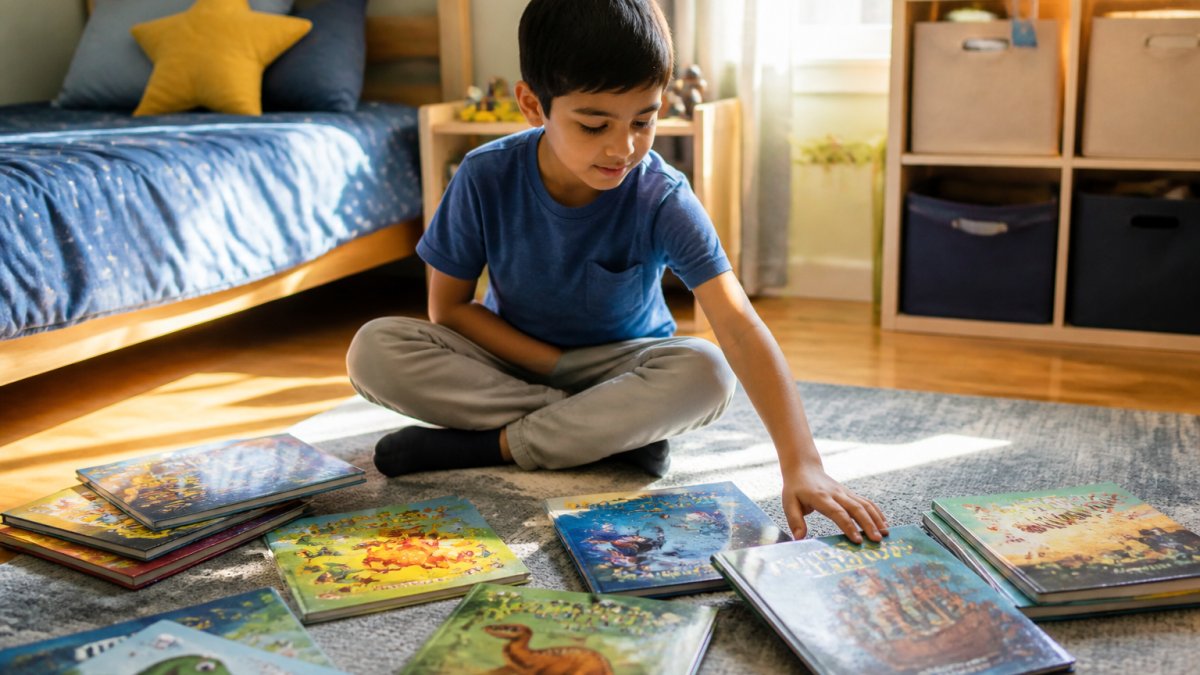
[IMAGE: A child sitting cross-legged on a bedroom floor surrounded by several colorful picture books, reaching for the next one, soft afternoon light through a window | section:Dino Time Explorers, Barkus, Bubble Dome Crew, and Ahoy!
Reading Fluency Strategies That Work With Any Story Universe
The program matters less than what you do with it. These reading fluency strategies work with any connected story world and cost nothing.
Repeated Reading and Oral Reading Practice at Home
Repeated reading means having a child read the same passage aloud more than once, aiming for smoother, more expressive reading each time. It is one of the most reliable ways to build fluency, and it works best when the text is already familiar.
A simple structure that holds up in practice:
- Read it together. You read the page aloud while your child follows along.
- Read it in unison. Both of you read at the same time, at a comfortable pace.
- Read it alone. Your child reads the same page without help.
- Read it with expression. Same page again, this time with feeling.
- Talk about it. Ask one question about what happened.
Five passes over one page beats one pass over five pages. The repetition is the point, not a sign something is wrong.
Reading Aloud Practice for Kids: A Simple 15-Minute Routine
Reading aloud practice for kids works best as a short, predictable routine rather than a long session.
Here is the routine we recommend to families using our story worlds:
- Minutes 1-2: Warm-up. Reread yesterday's page. Easy on purpose.
- Minutes 3-8: New reading. One or two new pages from the current book.
- Minutes 9-12: Rereading. Go back to the new pages and read them again.
The last three minutes are not filler. Talking about the story turns decoding practice into comprehension and makes a child want to come back tomorrow.
If your child resists, shorten the session rather than skipping it. Ten minutes daily beats forty minutes once a week, every time.
Engaging Reading Activities That Turn Stories Into Skill Builders
Engaging reading activities should pull the child back into the story world, not away from it.
- Character interview. You play reporter and your child answers as Neb or Lila, recalling details and speaking in full sentences.
- Predict the next realm. Before a new book, ask what they think the next doorway leads to. Then check.
- Draw the map. Have your child sketch the realms visited so far. Visual storytelling reinforces sequence, a core comprehension skill.
Notice what these have in common: none require a worksheet. A story universe supplies the material; the activity just gives the child a reason to go back into it.
Building reading fluency is not about finding a more exciting app or a harder book.
Capite Universe was built for exactly this.
Frequently Asked Questions
What is the most effective way to improve reading fluency?
The research points to repeated reading and oral reading practice as the most effective methods. When children read the same passage multiple times, they build speed, accuracy, and expression. Pairing repeated reading with a connected story universe keeps kids motivated to revisit characters and settings. A simple routine of 15 minutes daily, mixing independent reading with read-aloud sessions, produces steady fluency gains over weeks rather than months.
How can stories motivate children to practice reading?
Stories give children a reason to keep reading beyond the mechanics. When a narrative continues across multiple books, kids want to know what happens next to characters they care about. This intrinsic motivation drives voluntary reading practice, which is exactly what builds fluency. A connected universe like Infinite Dimensions or The Pendant of Many Realms turns reading practice into something children choose to do rather than something they are assigned.
How often should children practice reading aloud to build fluency?
Most reading specialists recommend 15 to 20 minutes of reading aloud practice for kids daily. Consistency matters more than duration. Five short sessions across the week beat one long weekend session. During read-aloud time, children should read material at their independent reading level so they can focus on pace and expression rather than struggling with unfamiliar words. Rotate between familiar texts for fluency and new texts for vocabulary growth.
What should parents look for in a reading program for kids?
Look for three things: a structured progression that builds across sessions, content that matches your child's age and reading level, and materials that keep your child wanting to return. Programs built around a continuing narrative score well on all three because story continuity creates natural motivation. Check whether the program offers printable activities, works across devices, and provides clear guidance for parents on how to support fluency practice at home.
How can you tell if a child's reading fluency is improving?
Listen for changes in pace, accuracy, and expression. A fluent reader moves through text smoothly, makes fewer decoding errors, and uses appropriate tone and pauses. You can track progress informally by having your child read a short passage aloud each week and noting how many words they read correctly per minute. Over four to six weeks of consistent practice, most children show measurable improvement in both speed and comprehension.


