Best Graphic Novels for Reluctant Readers: A Parent's Guide

Last Updated: November 1, 2026
Quick Summary
The best graphic novels for reluctant readers match the book to the child's interest first, then text density, then content notes. Start with Dog Man or Narwhal and Jelly for ages 6-8, Amulet for ages 9-11, and New Kid for ages 12-14. Read the first ten pages together tonight.
- Graphic novels lower the reading barrier without lowering the bar, since readers still decode words and follow plot.
- Use three filters in order: interest first, text density second, content notes third.
- Easy-reader graphic novels run roughly 1-3 short sentences and one to four large panels per page.
- Keep reading sessions short at 10 to 15 minutes for ages 6-8 and let your child re-read panels.
- Never use a graphic novel as a reward for finishing a real book, which teaches kids the format is lesser.
Table of Contents
- Why Graphic Novels Work for Reluctant Readers
- How Graphic Novels Help Reading Comprehension
- Choosing Graphic Novels by Age and Reading Level
- Graphic Novels for Beginning Readers
- What to Look For in a Graphic Novel for Your Child
- How to Introduce Graphic Novels at Home
- Where to Find Graphic Novels and Story-Driven Learning
- Frequently Asked Questions
Why Graphic Novels Work for Reluctant Readers
If your child groans at the sight of a chapter book but devours a comic in one sitting, you are not imagining the pattern. Graphic novels are one of the most effective on-ramps to reading for kids who resist traditional books, and the best graphic novels for reluctant readers lean on pictures, pacing, and humor to rebuild reading confidence rather than demand it.
The format works because it lowers the barrier without lowering the bar. Readers still decode words, follow plot, and infer meaning. They just get visual scaffolding along the way.
The Research on Comics and Reading Motivation
Educators have studied this for years. Educators have studied this for years, and research on graphic novels and young learners notes their classroom popularity and their appeal to reluctant readers.
Treat the evidence as directional rather than definitive. What we can say is that teachers keep reaching for these books for a reason.
If you want a fuller playbook beyond graphic novels, our guide on how to motivate reluctant readers covers nine strategies that pair well with visual formats.
How Graphic Novels Help Reading Comprehension
Graphic novels support comprehension by pairing every line of text with a visual cue, so readers get immediate context for vocabulary, tone, and plot. That picture-text support is exactly what struggling readers need: a running translation of what the words mean.
Speech bubbles, panel breaks, and illustrations all carry meaning. A reader who misses a word can still follow the story, which keeps momentum alive.
That momentum matters more than most parents realize. Kids who finish books build reading habits, and habits build skill. If you want to nurture that long-term, our article on fostering a love for reading in kids ages 6-14 goes deeper into the daily routines that stick.
Choosing Graphic Novels by Age and Reading Level
Match the book to the reader, not to the grade on the cover. A 10-year-old reading two years behind needs a story that respects their maturity while keeping the text manageable. Use three filters in this order: interest first, text density second, content notes third. Interest is the gatekeeper, if the topic does not connect to something your child already cares about, nothing else matters.
Here is the framework most librarians and reading specialists use, translated into plain terms you can apply in five minutes at the library:
| Age Band | What to Prioritize | Text Density | Sample Titles to Start With | Watch For |
|---|---|---|---|---|
| Ages 6-8 | Simple panels, humor, familiar characters | Low, roughly 1-2 short sentences per panel | Dog Man (Dav Pilkey), The Bad Guys (Aaron Blabey), Narwhal and Jelly (Ben Clanton) | Overly busy layouts; wordless spreads that confuse new readers |
| Ages 9-11 | Series, adventure, expanding vocabulary | Medium, short paragraphs, 3-5 sentences per page | Amulet (Kazu Kibuishi), Babysitters Club graphic adaptations, El Deafo (Cece Bell) | Themes slightly above readiness; mild peril in adventure series |
| Ages 12-14 | Respectful teen themes, real stakes | Higher, but still visual | New Kid (Jerry Craft), Roller Girl (Victoria Jamieson), Dragon Hoops (Gene Luen Yang) | Mature content notes, grief, identity, violence, romance |
Ages 6-8: Building Confidence with Visual Stories
For beginning readers, pick books with big panels, few words, and a clear through-line. Dog Man works because each page has one gag and one panel sequence; a child can finish a chapter in a sitting. Narwhal and Jelly uses very short sentences and repeated characters, which lowers the anxiety of a new book.
Keep sessions short, 10 to 15 minutes is plenty at this age, and let your child flip back to re-read panels. Re-reading is a confidence move, not a stall tactic.
Ages 9-11: Expanding Vocabulary and Story Complexity
At this stage, graphic novels can carry real plot: mysteries, friendships, adventures. Amulet stretches vocabulary across a multi-book arc, and El Deafo introduces memoir as a form. The illustrations still anchor meaning, but the text does more work. Look for series so your reader does not have to start over with a new cast every week.
If your child also struggles with decoding, our guidance on teaching reading comprehension to dyslexic students offers targeted methods that work alongside visual formats.
Ages 12-14: Respecting Older Readers' Interests
Teens who read below grade level often reject anything that looks babyish. New Kid and Roller Girl solve this because the format looks sophisticated even when the text is accessible, and both feature protagonists close to your teen's age. Choose titles with teen protagonists, real conflict, and themes that match their world.
Kids Personalized Story BOOK App →
Read the content notes first. Older graphic novels can tackle grief, identity, and violence, and you want to know before your teen does. A quick habit: flip to the middle of the book and read two pages yourself, you will see the text density and tone in under a minute.
Graphic Novels for Beginning Readers
Beginning readers need the simplest version of the format: one idea per page, short sentences, and pictures that do most of the storytelling. The trick is telling a true easy-reader graphic novel apart from a standard one, because publishers label them inconsistently. Use these four checks before you buy or borrow:
- Sentence count per page: Easy readers run roughly 1-3 short sentences per page. If a page has a full paragraph, it is not an easy reader.
- Panel count per page: One to four large panels. Six or more small panels signals a more advanced layout.
- Word count: Easy-reader graphic novels typically land in the 100-300 word range per chapter. You can estimate by counting one spread.
- Label check: Look for "easy reader," "leveled reader," or "early graphic novel" on the spine or back cover. The Narwhal and Jelly series is built for this stage.
Series like Dog Man and The Bad Guys, both built on slapstick humor and short, punchy panels, are popular choices for this age group. Humor is the secret weapon here. A kid laughing at a joke on page three will turn to page four.
Content Notes for Beginning Readers
Even simple graphic novels vary in what they contain. A few notes to preview before handing a book over:
- Dog Man: slapstick violence played for laughs (characters get flattened, bonked, and bounced back). Fine for most 6-8 year olds; preview if your child is sensitive to cartoon peril.
- The Bad Guys: mild villain humor, characters in peril, resolved comically. No real scares.
- Narwhal and Jelly: gentle friendship stories, no conflict beyond mild disagreement. The safest starting point for a sensitive reader.
Pairing Beginning Readers with Other Materials
Pair these with other supplementary reading materials for struggling learners so your child gets variety without losing the visual support that is working. A common pattern is to alternate one graphic novel with one leveled reader per week, the graphic novel builds stamina, and the leveled reader reinforces decoding.
What to Look For in a Graphic Novel for Your Child
Judge a graphic novel the way a teacher would. Five quick checks:
- Text density: Can your child read a page in under a minute?
- Panel clarity: Do the panels flow left to right without confusion?
- Interest match: Does the topic connect to something your child already loves?
- Content notes: Any themes you want to preview first?
- Series potential: Is there a book two, so momentum carries forward?
A common mistake is buying the most acclaimed title instead of the right one. Awards do not predict whether your specific reader will finish the book.
How to Introduce Graphic Novels at Home
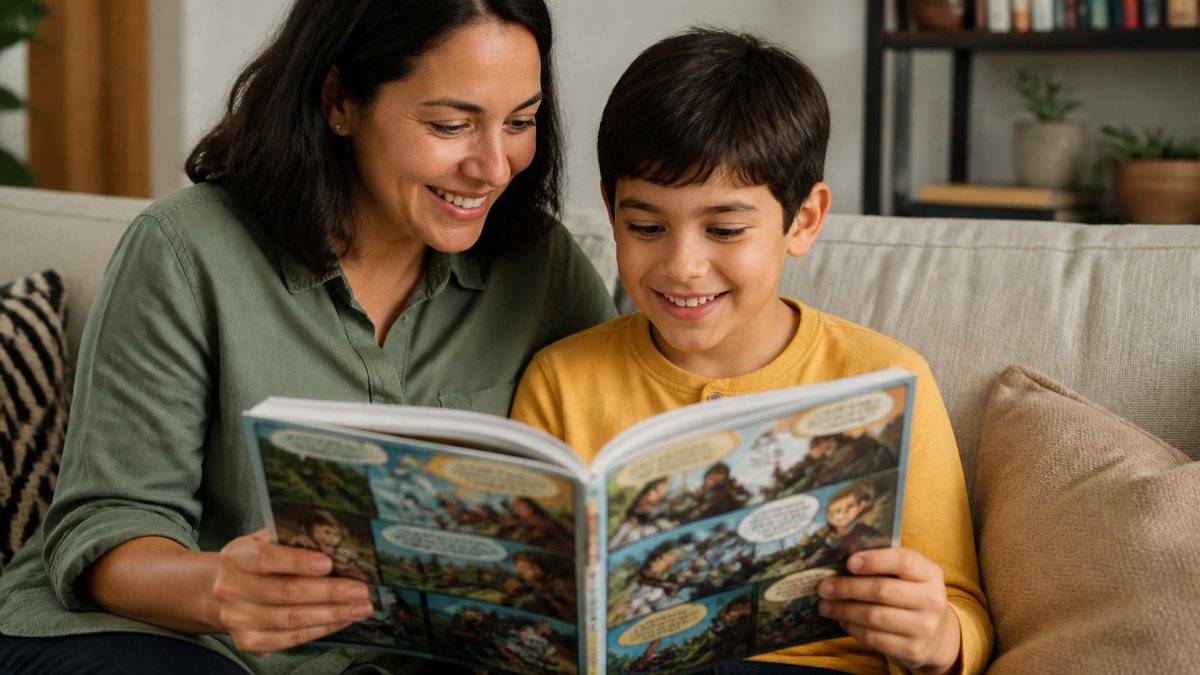
Start by reading one together, side by side, without quizzing. Let your child see you enjoy the format. Then hand over the next one and step back.
Three moves that work:
- Read the first chapter aloud, then let your child continue alone.
- Keep a small stack visible in the living room, not buried on a shelf.
- Ask what happened in the story, not what the words were.
Never use a graphic novel as a reward for finishing a "real" book. That teaches kids the format is lesser. It is not.
Where to Find Graphic Novels and Story-Driven Learning
Libraries and bookstores carry strong selections of graphic novels for young readers.
For families who want reading to feel like an adventure rather than an assignment, story-driven learning fills the gap between a single book and a full curriculum. That is what we build at Capite Universe.
Frequently Asked Questions
Are graphic novels good for reluctant readers?
Yes. Graphic novels pair illustrations with text, so readers get visual context clues that help them follow the story even when a word is unfamiliar. This picture-text support lowers the frustration that often makes reluctant readers give up. The format also builds reading confidence because children can finish a full book, which motivates them to pick up another. Educators continue to recommend them as a bridge to longer texts.
Which graphic novels are good for beginning readers?
Look for titles with large panels, few words per page, and clear speech bubbles. Series characters help beginning readers feel comfortable because they already know the cast. When selecting graphic novels for beginning readers, check that the text density is manageable and the vocabulary matches your child's level. Titles like Dog Man and The Bad Guys use humor and short sentences. Read a few pages together first to confirm your child can decode most words independently.
How do graphic novels help children build reading skills?
Graphic novels help reading comprehension by teaching children to connect text with images, track a sequence of events, and interpret dialogue in speech bubbles. That visual storytelling strengthens inference skills, because readers must read facial expressions and panel transitions to understand what is happening. Vocabulary grows through context, since illustrations often clarify an unfamiliar word. The format also builds reading engagement and stamina. A 2008 Texas Tech University study proposed using graphic novels in literature circles to motivate readers, and teachers continue to report that the format keeps students reading.
How can I encourage my child to read graphic novels?
Start by letting your child choose the title, since interest-based reading keeps motivation high. Read the first chapter together and talk about the pictures. Keep a few graphic novels in the car or by the bed so they are easy to grab. For ages 6-14, pair reading with a related activity, like drawing a favorite panel or retelling the story in their own words. Avoid quizzing them; the goal is reading habits and enjoyment. Once they finish one book, have the next in the series ready.
Your reluctant reader does not need pressure. They need the right book, handed over without a lecture, at the right moment. Capite Universe turns that moment into a habit, with story-driven adventures that build reading, critical thinking, and creativity for kids ages 6-14, printable activities you can use today, and instant digital access so the next chapter is never more than a click away. Get started with Capite Universe and watch your child ask for the next story instead of avoiding it.


