Best Easy Logic Games for Kids: Structured Learning

Table of Contents
- Why Structured Logic Games for Kids Beat Unstructured Play
- How We Evaluated These Logic Games for Kids
- Code In Time Full Lesson: Best for Computational Thinking and Sequencing
- Grandpa Wisdo Lesson Books: Best for Gentle, Reflective Reasoning
- Famous Men Life Stories: Best for Real-World Problem-Solving Models
- Comparison Table: Which Resource Fits Your Learner?
- How to Build a Weekly Progression with Logic Games for Kids
- Conclusion: Choosing the Right Tool for Your Home or Classroom
- Frequently Asked Questions
Last Updated: October 9, 2026
Why Structured Logic Games for Kids Beat Unstructured Play
Structured logic games for kids produce better reasoning gains than free play alone because they pair a clear goal with a defined sequence of thinking steps.

That gap matters. Children who can solve a puzzle often still struggle to describe their reasoning out loud, the skill that transfers to math, science, and reading comprehension.
This is the approach we take at Capite Universe: story-driven lessons with a fixed lesson flow, a hands-on challenge, and a reflection step at the end.
How We Evaluated These Logic Games for Kids
Most roundups call a resource "great for critical thinking" and stop there, not enough to plan a week, let alone a semester. We scored every resource on six criteria, weighting the two competitors rarely mention: whether the reasoning skill is named, and whether an adult can observe growth.
Here is the full rubric:
| Criterion | What We Looked For | Weight | Why It Matters |
|---|---|---|---|
| Setup time | Under 10 minutes from opening the file to starting | Medium | Materials that sit unused help no one |
| Difficulty range | Adjustable across ages 6-14 | High | One purchase should serve siblings or a mixed class |
| Named skill | States the reasoning skill directly (sequencing, classification, cause and effect) | High | Makes progress tracking possible |
| Reflection step | Built into the lesson, not bolted on | High | Reasoning improves when kids explain their thinking out loud |
| Printable materials | Included or downloadable, not screen-only | Medium | Teachers need handouts for a group of 25 |
| Assessment hook | A prompt, checklist, or observable behavior the adult can record | High | Turns practice into measurable growth |
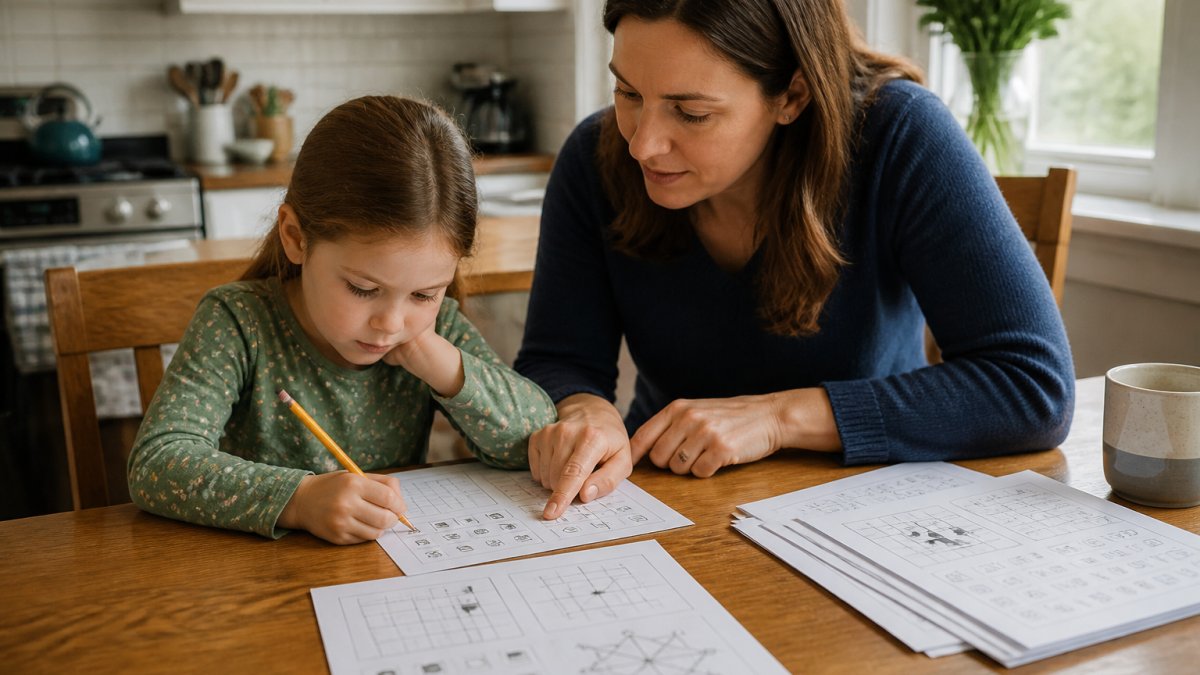
What the assessment hook actually looks like
An assessment hook is any built-in moment where the adult can watch a specific behavior and record it. Three examples:
- A debrief question at the end of a lesson ("Which step did you change, and why?") that reveals whether the child can explain their reasoning, not just produce an answer.
- A challenge with a stated objective ("sort these ten items into two groups and name your rule") so the adult knows what success looks like before the child starts.
- A reflection prompt the child answers in writing, which doubles as a portfolio artifact for a homeschool record or a parent-teacher conference.
Many teachers keep a simple three-column log: skill practiced, what the child solved independently, and what required a prompt. After four sessions, the pattern is visible without formal testing.
How to adapt any activity across ages and abilities
Age ranges on a product page are a starting point, not a rule. The same puzzle can serve a 6-year-old and a 12-year-old if you change one variable at a time:
- Younger or hesitant learners: reduce the number of items to sort, pre-cut the pieces, and read the prompt aloud. The reasoning task stays the same; the load on working memory and reading drops.
- Older or advanced learners: add a constraint ("sort them two different ways and explain which rule is stronger") or remove a hint. Adding a second valid answer is usually more demanding than adding more items.
- Neurodiverse learners: offer the same task in a different format. A child who stalls on a written logic grid may solve the identical problem with physical cards or by talking it through. Keep the reasoning target fixed and vary the delivery.
A common mistake is buying three resources that target the same skill. Our scoring favors resources covering different reasoning skills so a weekly plan can rotate between them, and resources that name the skill so you know which to reach for next.
Code In Time Full Lesson: Best for Computational Thinking and Sequencing
Code In Time is the strongest pick for sequencing, algorithms, and cause-and-effect reasoning. It teaches coding concepts without a computer, so it works with one shared device or none.

The lesson follows a fixed five-part flow: a realm briefing, a story event where a timeline glitch appears, a skill spotlight, a hands-on challenge, and a debrief where learners explain their reasoning.
Pros:
- Named skills: sequencing, algorithms, debugging, pattern recognition, cause and effect
- Printable activity sheets, logic grid challenges, and timeline repair puzzles included
- Teacher guide with answer keys removes prep work
Cons:
- It is a single module, so it works best as one unit in a longer progression rather than a full curriculum
- The narrative framing will land better with kids who enjoy story-driven content
Code In Time Full Lesson
Grandpa Wisdo Lesson Books: Best for Gentle, Reflective Reasoning
The Grandpa Wisdo series is best for younger or hesitant learners who need reasoning practice delivered calmly.

Book 2 (A Edition) shifts from learning about wisdom to practicing it, adding reflective curiosity, emotional mapping, kindness with boundaries, and patience in action.
Where it falls short: there are no puzzles or timed challenges, so it will not satisfy a child who wants competition.
Famous Men Life Stories: Best for Real-World Problem-Solving Models
The Isaac Newton lesson is the best resource here for showing kids what problem-solving looks like in practice.
That framing is the teaching tool: children see a real person hit obstacles, follow curiosity, and revise his thinking, giving them a model to imitate when their own first attempt fails.
The limitation is scope: it is a narrative, not an activity pack, so it needs a discussion question or a written response to turn reading into reasoning practice.
Famous Men Life Stories Lesson 1 A Isaac Newton
Comparison Table: Which Resource Fits Your Learner?
| Resource | Price | Reasoning Skill | Best Age Range | Reflection Built In |
|---|---|---|---|---|
| Code In Time Full Lesson | $7.99 | Sequencing, algorithms, debugging, cause and effect | 8-14 | Yes, debrief step |
| Grandpa Wisdo Book 1 (Y Edition) | $4.99 | Observation, curiosity, decision-making | 6-10 | Yes, Wisdo Moment |
| Grandpa Wisdo Book 2 (A Edition) | $4.99 | Reflective reasoning, emotional mapping | 10-14 | Yes, chapter challenge |
| Famous Men Life Stories: Isaac Newton | $4.99 | Real-world problem-solving models | 8-14 | Needs a discussion prompt |
| Pridely's Caveman Quick Facts Cheat Sheet | $4.99 | Compare and classify, vocabulary | 6-11 | No, reference sheet |
For a fuller picture of how these fit together, Edutopia's coverage of play-based and structured learning is worth reading alongside this table.
How to Build a Weekly Progression with Logic Games for Kids
A workable weekly plan rotates one reasoning skill per session, states the objective before you start, and ends with a short verbal debrief. That structure turns a pile of activities into a progression.
Here is a four-week sequence with objectives, materials, and timing. Run it as written, then repeat the cycle at a harder level.
Week 1: Foundations
| Day | Skill | Objective | Materials | Time |
|---|---|---|---|---|
| Monday | Pattern recognition | Child can name the rule behind a repeating pattern | Logic grid or timeline puzzle | 10 min |
| Tuesday | Sequencing | Child can order five steps and explain why the order matters | Code In Time skill spotlight + hands-on challenge | 20 min |
| Wednesday | Reflective reasoning | Child can restate a story's main idea in their own words | One Grandpa Wisdo chapter | 15 min |
| Thursday | Real-world modeling | Child can describe what a problem-solver tried after failing | One Famous Men lesson | 15 min |
| Friday | Compare and classify | Child can sort facts into two named categories | Caveman cheat sheet | 10 min |
| Weekend | Open-ended discussion | Child can defend a choice with a reason | None | 10 min |
Week 2: Add a constraint
Keep the same rotation but raise difficulty on one day only. Monday: sort the same items a second way and explain which rule is stronger. Tuesday: remove one hint. Wednesday: predict what a character will do next before reading on.
Week 3: Transfer
This week proves the skill stuck. Swap the materials but keep the skill: if Monday was a logic grid in Week 1, use a timeline puzzle in Week 3. If the child solves the new format without a reminder, the reasoning transferred. If not, drop back one step and rebuild.
Week 4: Assess and adjust
Repeat Week 1 exactly and compare. The gap between the two runs is your progress data.
How to track progress in three columns
Keep a running log with three columns: skill practiced, what the child solved independently, and what they needed help with. After four weeks, two signals matter most:
- Independence rate: the share of sessions where the child finished without a prompt. Rising independence on the same skill is the clearest sign of growth.
- Transfer: whether the child can apply the skill to a new format or a new subject. A child who sorts facts on Friday and then sorts evidence in a science lesson has transferred the skill.
Many teachers record one sentence per session rather than a score. Over a month, those sentences describe growth more accurately than a number would.
Classroom adaptations
A 45-minute class period fits two of the daily blocks above, not six. Run the rotation across two weeks and use the Friday classification task as a warm-up. For group work, assign roles: one student reads the prompt, one proposes a rule, one challenges it, and one reports the group's reasoning. That reporting role is where reasoning becomes visible.
The Common Core State Standards Initiative outlines the reasoning expectations schools work toward, which helps homeschool families align at home.
Conclusion: Choosing the Right Tool for Your Home or Classroom
The hardest part of building logical reasoning is not finding activities. It is keeping them structured enough to repeat and varied enough to cover more than one skill.
That is the problem we built Capite Universe to solve.
Get started with Capite Universe and give your learner a structured path through logic games for kids that you can actually keep up with.
Frequently Asked Questions
How can parents help children develop logical reasoning?
Start with short, structured sessions using logic games for kids that have clear instructions and adjustable difficulty. Work alongside your child for the first few rounds, asking open-ended questions like 'What do you think happens next?' and 'Why did you choose that?' Resources like Code In Time Full Lesson provide printable activity sheets and a teacher guide with answer keys, so you can guide the reasoning without needing to invent activities yourself.
What are some good problem-solving activities for kids?
Effective problem-solving activities for kids include logic grid challenges, timeline repair puzzles, sequencing tasks, and story-based missions where children must debug a broken sequence. Code In Time Full Lesson includes timeline repair puzzles and logic grid challenges that build cause-and-effect reasoning. For younger learners, Grandpa Wisdo Lesson Book 1 Y uses short stories to teach observation and patience, which are foundational problem-solving skills.
Are logic games effective for developing critical thinking in kids?
Yes. Logic games for kids that require pattern recognition, sequencing, and debugging build the same mental structures used in programming and scientific reasoning. Code In Time Full Lesson explicitly targets sequential reasoning, logical clarity, and persistence through its mission-based structure. The debrief and reflection step in each lesson asks learners to explain their reasoning and explore alternate solutions, which strengthens critical thinking more than passive activities.
How can teachers make reasoning activities easy to use in the classroom?
Choose resources that include a teacher guide, answer keys, and multi-age differentiation notes. Code In Time Full Lesson provides a full cinematic lesson script, printable activity sheets, and differentiation notes, so you can run the same lesson across grade levels without rewriting it. Pridely's Caveman Quick Facts Cheat Sheet works as a fast lesson companion or study guide with key vocabulary already defined.
What screen-free critical thinking activities work for homeschooling?
Printable logic puzzles, story copywork, and guided discussion questions all work without a screen. Grandpa Wisdo Lesson Book 1 Y and Book 2 A are digital downloads you can print and read together, with reflection questions built into each chapter. CUCWA Cursive Writing App also offers printable worksheets that support fine motor skills and focus, which complement screen-free reasoning practice.


