Benefits of Immersive Learning for Kids: A Guide

Table of Contents
- What Is Immersive Learning and How Does It Work?
- Knowledge Retention: Why Immersive Learning Sticks
- Enhanced Student Engagement Through Interactive Scenarios
- Active vs. Passive Learning Strategies: Building Critical Thinking
- Developing Soft Skills and Empathy in Immersive Environments
- Best Educational Apps for Critical Thinking and Real-World Application
- How to Balance Screen Time for Kids While Maximizing Learning
- Addressing Parental Concerns: Implementation Costs and Age-Appropriate Guidelines
- Frequently Asked Questions
Last Updated: September 21, 2026
What Is Immersive Learning and How Does It Work?
Immersive learning for kids is an educational approach that uses interactive, story-driven environments to help children actively participate in their own learning journey. Rather than passively consuming information, students engage with content through simulated environments, interactive scenarios, and multisensory experiences that make abstract concepts tangible and memorable.
Immersive learning works by combining narrative storytelling with educational content, creating what researchers call experiential learning, where children learn by doing, exploring, and discovering rather than simply listening or reading. When a child navigates a virtual kingdom to solve a math problem or explores an ancient civilization through an interactive adventure, their brain processes the information differently than it would in a traditional classroom setting.
The mechanics are straightforward: a child encounters a challenge within a story context, applies critical thinking to solve it, and immediately sees the real-world consequences of their choices. This active participation triggers deeper cognitive processing and stronger knowledge retention compared to passive instruction.
Knowledge Retention: Why Immersive Learning Sticks
When children engage multiple senses and emotional responses simultaneously, their brains form stronger neural connections than during passive instruction. A child who guides water droplets through a simulated ecosystem, watching clouds form, rain fall, and rivers flow, builds a mental model they'll remember for years.
Active participation requires children to make decisions, predict outcomes, and adjust strategies based on feedback, each action strengthens memory. When learning is embedded in narrative, the story itself becomes a retrieval cue.
Immersive learning environments can reduce the need for repetition.
When information connects to a character's journey, children understand relationships between concepts, the difference between knowing that photosynthesis happens and understanding why it matters to an ecosystem.
Enhanced Student Engagement Through Interactive Scenarios
Immersive learning shows its clearest advantage in engagement. Traditional passive learning places the burden of motivation entirely on the child; immersive environments create conditions where engagement happens naturally.
Interactive scenarios tap into intrinsic motivation. When children make choices that matter within the story, motivation shifts from external (grades, approval) to internal (genuine curiosity and desire to succeed).
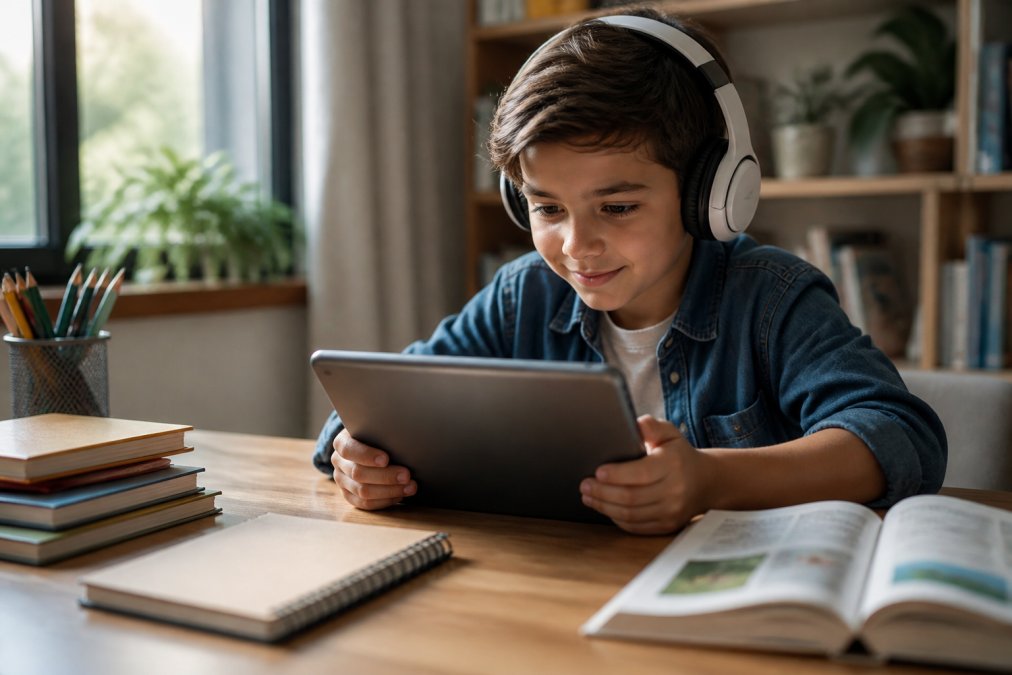
Story-driven adventures where children become the protagonist transform skill-building into exploration, allowing them to build reading, critical thinking, and creativity skills while navigating meaningful narratives.
Immersive, story-driven platforms address screen time anxiety by replacing passive consumption with active problem-solving, decision-making, and creative thinking.
:::pro-tip The most engaged learners aren't those with the most screen time, they're the ones where every interaction requires a decision or creative response. Look for platforms where children do things, not just watch things.
Active vs. Passive Learning Strategies: Building Critical Thinking
The distinction between active and passive learning determines whether children develop genuine critical thinking or simply accumulate facts. Passive learning allows children to remain mentally inert; they receive information without processing it deeply.
Active learning demands that children engage with material, question it, apply it, and defend their thinking. Immersive learning for kids excels here: children predict outcomes, test hypotheses, and adjust strategies based on results.
Immersive environments push children toward active learning.
Passive strategies are easier to implement but rarely develop critical thinking skills. Active strategies, where learners make decisions and solve problems, build mental flexibility and reasoning skills that transfer to new situations.
The best immersive platforms intentionally design scenarios where there's no single "correct" path. Children make choices, see consequences, and learn to think through problems from multiple angles. This mirrors real-world problem-solving far more accurately than traditional instruction.
Kids Personalized Story BOOK App →
Developing Soft Skills and Empathy in Immersive Environments
Beyond academic knowledge, immersive learning environments build what educators call soft skills, communication, collaboration, empathy, and emotional intelligence. These skills rarely develop through traditional instruction because traditional classrooms don't create the conditions where they naturally emerge.
Immersive scenarios, particularly story-driven ones, place children in situations where they must consider perspectives beyond their own. When a child guides a character through a moral dilemma, they're not just learning content, they're practicing empathy and perspective-taking. They're considering how their choices affect others, what motivates different characters, and how to navigate complex social situations.
The narrative context matters tremendously here. A child reading about historical injustice in a textbook might feel disconnected from it. A child experiencing that same history through an interactive adventure where they must make decisions and see their consequences develops a deeper emotional understanding. This emotional engagement strengthens memory and builds genuine empathy rather than abstract knowledge.
Soft skills development also happens through the social structures within immersive platforms. These interactions build communication skills and expose children to different problem-solving approaches. They learn that there are multiple valid ways to approach challenges, a crucial realization for developing flexible, creative thinking.
Best Educational Apps for Critical Thinking and Real-World Application
When selecting immersive learning for kids platforms, focus on apps that prioritize active problem-solving and real-world application over passive consumption.
Capite Universe stands out because it combines story-driven narratives with structured skill-building. The platform delivers instantly accessible content that's teacher-approved and designed specifically for children ages 6-14. Rather than treating stories and learning as separate experiences, Capite Universe integrates them, children build reading, critical thinking, and creativity skills while exploring galaxies and ancient kingdoms. The Kids Personalized Story Book App ($7.99) creates unique adventures starring each child as a character, increasing engagement through personal relevance. For older learners developing study habits, the Every Day Study Helper App ($8.99) and Every Day Flash Card App ($6.99) provide structured tools for organizing and reviewing material.

The advantage of story-driven platforms is that they address a real problem: many children disengage from learning because it feels disconnected from their interests. When learning happens within a narrative they care about, engagement follows naturally. Real-world application emerges because children solve problems within meaningful contexts rather than abstract exercises.
When evaluating educational apps, look for these markers of quality:
- Content is teacher-approved and aligned with educational standards
- The platform combines entertainment with genuine skill-building
- Children make meaningful choices that affect the story
- The interface is intuitive enough that children can navigate independently
- Progress is visible and motivating
| Feature | What to Look For | Why It Matters |
|---|---|---|
| Story Integration | Narratives drive learning, not just entertain | Children stay engaged longer and retain more |
| Active Scenarios | Problems require decision-making and strategy | Builds critical thinking, not just content recall |
| Age Appropriateness | Content matches developmental level | Prevents frustration and maintains engagement |
| Progress Tracking | Children see their own advancement | Builds motivation and sense of accomplishment |
| Teacher Approval | Content aligns with educational standards | Ensures genuine learning, not just entertainment |
How to Balance Screen Time for Kids While Maximizing Learning
The screen time conversation often gets framed as binary: screens are either good or bad. The reality is more nuanced. The quality of screen time matters far more than the quantity. An hour spent in passive video consumption is fundamentally different from an hour spent solving problems in an interactive environment.
The key is intentional design. Immersive learning platforms that require active participation create what researchers call student-centered learning, where children drive their own learning process through choices and exploration. This is distinctly different from passive screen time. A child watching educational videos is consuming information. A child navigating an interactive story and solving problems to progress is actively learning.
Parents often worry that any digital learning means excessive screen exposure.
Practical strategies for balancing screen time include:
- Set clear boundaries on total screen time, but prioritize quality over quantity
- Choose platforms where children must actively participate, not passively consume
- Combine digital learning with offline activities, use immersive apps as one tool among many
- Monitor engagement; if a child is genuinely problem-solving and thinking critically, it's educational screen time
- Use story-driven platforms where narratives create natural stopping points rather than endless scrolling
Addressing Parental Concerns: Implementation Costs and Age-Appropriate Guidelines
Parents considering immersive learning for kids often have legitimate questions about cost, age-appropriateness, and whether these platforms actually deliver on their promises. Addressing these concerns directly builds confidence in the approach.
Frequently Asked Questions
Can you give me a concrete example of immersive learning in action?
Immersive learning combines story-driven narratives with interactive problem-solving. For instance, a child exploring an ancient kingdom adventure might solve math puzzles to unlock a treasure chest, or read passages to guide a character through challenges. Story-driven platforms like Capite Universe blend these elements, where kids become characters in adventures that require reading comprehension, critical thinking, and decision-making, turning passive consumption into active participation.
How does immersive learning improve critical thinking compared to traditional methods?
Traditional methods often present information passively; immersive learning requires kids to think, choose, and problem-solve within simulated environments. When children navigate real-world scenario simulations, deciding how a character responds to conflict or solving puzzles to progress, they engage cognitive processing at a deeper level. This active participation builds reasoning skills, adaptability, and the ability to apply knowledge across different contexts rather than memorizing facts.
What's the difference between active and passive screen time in education?
Passive screen time involves watching videos or consuming content without interaction. Active screen time requires the child to make choices, solve problems, or respond to prompts. Immersive learning platforms emphasize active participation, kids engage with interactive scenarios, answer questions that drive the story forward, and see their choices shape outcomes. This transforms screen time from entertainment into a learning tool that builds knowledge retention and skill acquisition.
How can parents integrate immersive learning into a child's daily routine without excessive screen time?
Set specific, structured time blocks, such as 20-30 minutes after homework or before dinner, rather than open-ended access. Pair immersive learning with offline activities: print accompanying worksheets, discuss story outcomes, or extend lessons into hands-on projects. Platforms like Capite Universe offer printable activities alongside digital content, allowing you to blend screen-based and screen-free learning. This approach maintains engagement while respecting healthy screen-time boundaries.


